
 Farnborough
 Nice
Nice

What Are Shared Private Jet Flights? (And What They're Not)
Shared charter puts multiple unacquainted passengers on the same aircraft, each paying a proportional share of the total seat cost. It is a distinct booking model with its own operating logic, pricing structure, and target passenger profile, and conflating it with the alternatives costs travellers money and produces real disappointment.
The confusion is partly the industry's fault. Shared private jet flights are not empty legs. An empty leg is a repositioning flight that happens to have unsold seats: it has a fixed departure window, no guarantee of consistency, and a tendency to appear and disappear with limited notice. Shared charter is a scheduled or semi-scheduled service where individual seats are sold from the outset, typically with a booking window of five to twenty-one days.
Fractional ownership is equally different. Acquiring a share in a managed aircraft programme delivers guaranteed availability, a dedicated fleet, and a consistent cabin experience across hundreds of hours. Shared flights offer none of that, but they also carry none of the capital outlay, the annual management fees, or the long-term commitment that fractional programmes require.
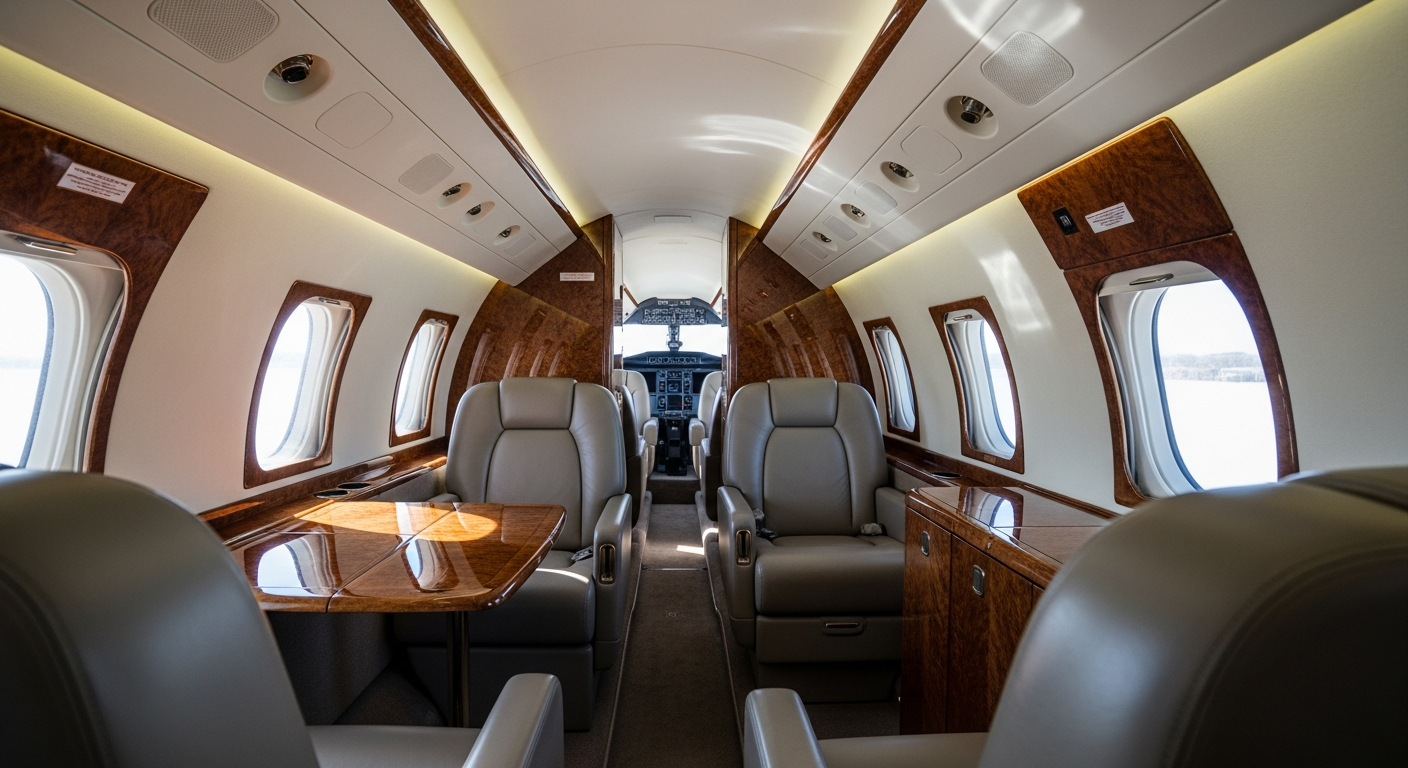
The closest analogy in commercial aviation is a business-class seat on a thin regional route, stripped of the airport terminal, the check-in queue, the boarding announcement, and the middle seat. A Cessna Citation Longitude departing from EGLF Farnborough at a time negotiated around passenger consensus is a materially different product from a scheduled flight. Understanding that distinction is the starting point for deciding whether the model fits your requirements.
How Shared Charter Pricing Works: What You're Actually Paying For
Charter operators calculate the seat price by dividing the total aircraft cost across confirmed bookings. If a Phenom 300E from LSGG Geneva to EGLL London is priced at £9,500 for the aircraft and four passengers book, each pays approximately £2,375 before taxes and handling fees. The arithmetic appears transparent, but several variables sit underneath it.
Operators typically hold a minimum-fill threshold. If bookings fall short, the flight either consolidates with an adjacent departure, converts to a private charter at a higher individual cost, or cancels. Each operator sets its own threshold, and the specific terms are worth confirming before you commit to a schedule.
The product each passenger is buying is twofold: a per-seat cost that falls materially below full charter, and an experience that is substantially better than commercial alternatives. The calculation is most straightforward on routes where commercial alternatives are thin. EGLF to LSGG has no direct scheduled equivalent; the shared charter price reflects genuine access to a service structure that commercial aviation cannot replicate.
On short-haul European routes, the time saved at each end of the journey can account for ninety minutes to two hours of recovered productivity per trip. Bypassing EGLL's main terminal in favour of a private FBO is not a marginal improvement; on a tight schedule, it is the difference between a functional travel day and a wasted one.
Service calibration on shared flights is lower than on full charter. Catering tends to be standardised rather than personalised; departure times are agreed rather than chosen. If a fellow passenger requires a fifteen-minute delay for a late connection, that delay is absorbed by everyone on board. These are not objections to the model; they are features of it, and booking with a clear understanding of the trade-offs produces a far better experience than booking with unrealistic expectations.
Shared Flights vs Empty Legs vs Full Charter: Choosing the Right Model
The decision between models comes down to three variables: schedule firmness, privacy requirement, and flight frequency.
Empty legs are opportunistic by definition. Pricing is often the lowest of the three options, but the trade-off is a lack of control over timing and routing. Legs surface with limited notice, windows shift, and occasional cancellations are part of the model. They suit travellers who can adapt their schedule to an opportunity, not those with a fixed arrival requirement.
Full charter sits at the opposite end. You set the schedule, select the aircraft type, and design the experience entirely. Full charter on a Gulfstream G650ER from EGLL to LPPT Lisbon takes approximately two hours and twenty minutes; the cabin is wide enough and long enough that four passengers have genuine room to work separately. Nothing about the experience is shared or negotiated with strangers.
Shared private jet flights occupy a productive middle position. Schedules are more structured than empty legs, costs are controlled relative to full charter, and the aircraft quality is generally reliable. For a solo traveller or a couple flying a high-frequency European corridor, sharing is coherent in a way that justifies careful consideration rather than reflexive rejection.
The price comparison is instructive. On a route like EGLF to LSZH Zurich, a shared seat on a Phenom 300E might price between £1,800 and £2,500. Full charter for the same aircraft and route typically costs £7,000 to £9,500. The shared model is not a discounted version of the full charter product; it is a different product that uses the same aircraft and delivers the same private terminal experience at a structurally lower individual cost.

The Best Routes and Aircraft Types for Jet Sharing
Short-haul European city pairs are the natural habitat of shared charter. Routes between London, Paris, Geneva, Zurich, Amsterdam, and Milan carry sufficient demand density to make passenger consolidation viable without extended booking windows or last-minute schedule changes. EGLF to LSGG is one of the most consistently served shared corridors. EGLL to LFPB Paris Le Bourget is another.
Aircraft selection is more consequential in shared charter than in full charter. Light jets, particularly the Embraer Phenom 300E, offer the optimal combination of cabin size, operating economics, and per-seat pricing. Seating four to six passengers with a range of approximately 1,800 nautical miles, the Phenom 300E covers the majority of European short-haul routes without a fuel stop, making it the default choice for shared programme operators.
The Cessna Citation Longitude adds cabin length and extends viable range to around 3,500 nautical miles, appropriate for routes into the eastern Mediterranean or Iberia without the operating overhead of a larger aircraft. For departures from EGLL to LPPT or LEMD Madrid, the Citation Longitude is often the most efficient platform for a shared departure.
Mid-size and large-cabin aircraft create complications in the shared model. A Dassault Falcon 8X, with its three-engine configuration and a cabin height of 1.88 metres, is an exceptional aircraft, but filling eight to fourteen seats on a shared basis requires demand density that most routes cannot sustain. Operators running structured shared programmes tend to stay within the light-to-upper-light segment for precisely this reason.
Transatlantic shared flights exist, but the calculation changes significantly. A six-to-eight-hour crossing on a Bombardier Global 7500 with unknown co-passengers is a different social dynamic to a ninety-minute hop to Geneva. At that range, handling charges, Atlantic crossing fees, and overflight permits begin to compress the per-seat saving relative to business class on a commercial carrier.
Seasonal demand clusters are worth knowing. The ski-season corridor into LSGG and LSZH, running from November through April, consistently produces some of the most competitively priced shared flights in European private aviation. Operators build programmes around predictable demand, which means better availability, cleaner pricing, and fewer last-minute consolidations.
How to Book a Shared Private Jet Flight: Timing, Flexibility, and What to Expect
Most operators open shared flight listings five to twenty-one days before departure, closing bookings once the aircraft is full or the minimum-fill threshold is confirmed. Booking early on popular corridors secures the best departure time options; leaving it late is possible, but seat choice narrows quickly on high-demand routes.
The booking process differs from full charter in a fundamental respect: you are fitting your travel requirement to an existing flight rather than building the flight around you. On busy corridors this is rarely constraining, because multiple departures are typically available across the day. On thinner routes, a one-to-three-hour adjustment to your preferred departure time may be necessary.
Identity verification is standard and applies to all passengers on the flight. Passport details are required in advance, and operators may share basic passenger information across the group for security screening purposes. This is not unusual and does not represent a meaningful privacy concern for most travellers.
Luggage capacity is worth confirming at the point of booking. The Phenom 300E has a nose baggage compartment of approximately two cubic metres, which handles standard carry-on volume per passenger comfortably but will not accommodate bulky sports equipment. Shared private jet flights are not generally appropriate for ski or golf travel unless the operator can confirm additional hold capacity on the specific departure.
The terminal experience holds regardless of how the seat was priced. Private FBO facilities, no queuing, security cleared in minutes, access to a lounge ahead of boarding: these do not change with the booking model. From EGLF, the time from car to airborne is typically under thirty minutes. That compression of airport friction is the core value of private aviation, and it survives intact in the shared model.
For travellers flying the same European corridor regularly, shared private jet flights have the potential to become a sustainable weekly fixture rather than a one-off test. The economics hold at scale, the repeat booking process is straightforward, and the FBO experience never deteriorates. The question is not whether the model is premium enough; it is whether your schedule and route fit the conditions under which it works best.