 Farnborough
 Nice
Nice
What Makes the Gulfstream G700 Different from Its Predecessors
The Gulfstream G700 private jet didn't simply replace the G650ER; it was engineered from a blank sheet to redefine what a purpose-built long-range business aircraft could achieve. Gulfstream unveiled the type at NBAA 2019, with first deliveries entering service in 2022, and the improvements over the G650ER are substantial rather than incremental.
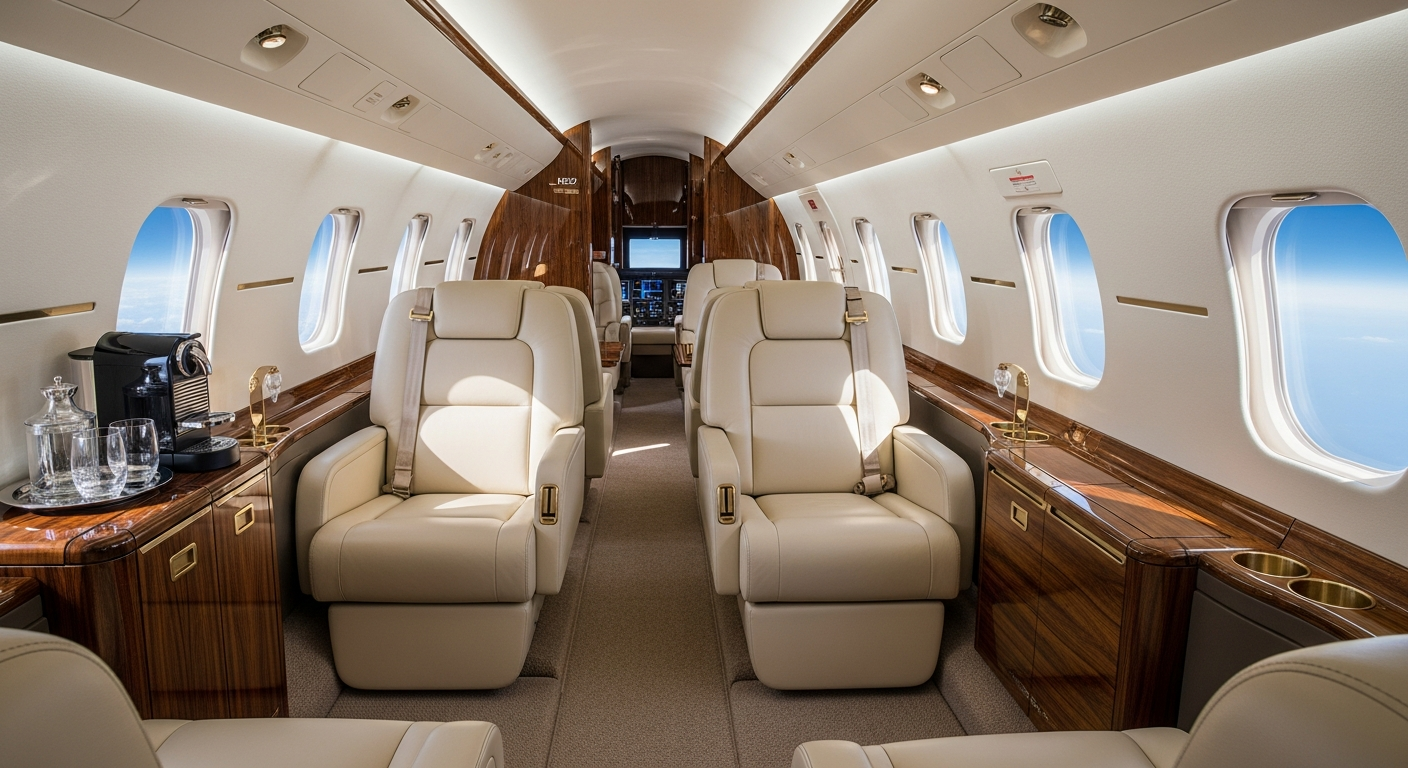
The most immediate difference is size. At 56 feet (17.07 metres) in length, the G700's interior is nearly 10 feet longer than the G650ER's 46.5-foot cabin. That difference is not trivial when you are spending 14 or 16 hours at altitude. Headroom reaches 6 feet 3 inches (1.91 metres), and cabin width stretches to 8 feet 2 inches (2.49 metres), dimensions that translate directly into a qualitatively different experience in the air: more space to move, more separation between living zones, and a genuinely residential feel.
The 20 panoramic oval windows are the largest fitted to any purpose-built business jet in production. Each is significantly bigger than those on the G650ER, and the distribution of natural light through the cabin changes the atmosphere in a way photographs do not fully capture. At 45,000 feet, the interior feels less enclosed and considerably more open.
Propulsion comes from Rolls-Royce Pearl 700 engines, a generation ahead of the BR725 units powering the G650ER. They deliver higher thrust-to-weight efficiency, support a maximum speed of Mach 0.935, and measurably improve fuel burn per nautical mile. For operators managing high-utilisation charter programmes, that efficiency advantage accumulates quickly over a full year of flying.
Gulfstream also introduced Circadian Lighting: a cabin system cycling through 1.3 billion colour and intensity combinations to support the body's natural rhythm on long overnight sectors. This is not a marketing feature. For clients regularly crossing five or six time zones in a single leg, the effect on arrival condition is documented and real. No equivalent exists in the G650ER's specification.
Cabin Layout, Comfort, and Living Zones in Detail
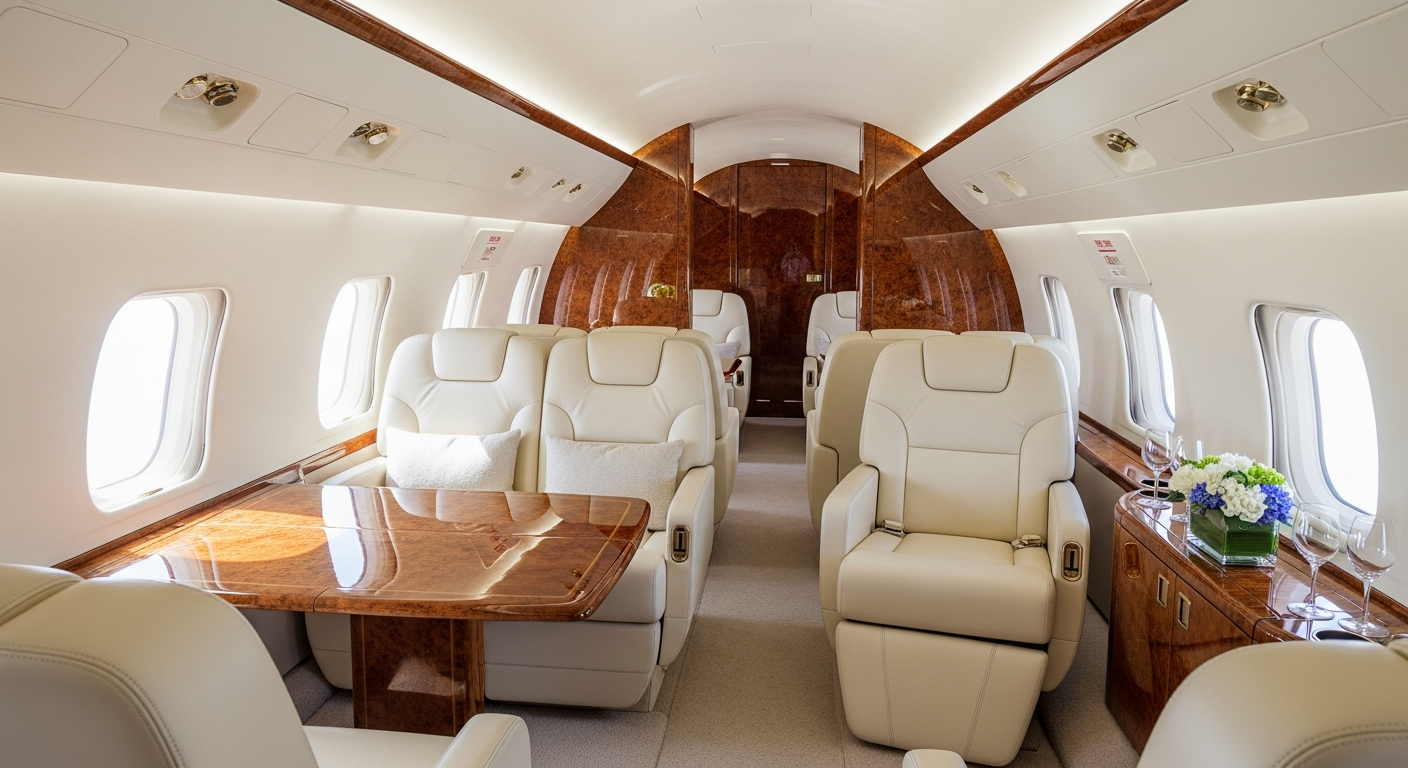
A Gulfstream G700 private jet configured for charter typically accommodates between 14 and 19 passengers depending on the interior specification. Most charter configurations prioritise comfort over density, and the standard arrangement divides the interior into four distinct living zones, each designed with a specific function.
The forward section houses individual club seating or dual-side divans, typically set up as the primary working area. Connectivity is strong throughout: the G700 supports simultaneous Ka-band and Ku-band satellite systems, delivering reliable broadband above 45,000 feet where Wi-Fi on smaller aircraft routinely drops. For clients who need uninterrupted connectivity on a transatlantic or transpacific crossing, this is more dependable than most alternatives currently available in the charter market.
The mid-cabin typically holds a formal dining area seating six to eight, with a fixed table and full catering service from the adjacent galley. Meals are served properly at the table rather than on fold-out trays. The G700's galley is fully equipped with convection ovens, microwave, deep refrigeration, and substantial storage for multiple courses. Its footprint is measurably larger than the G650ER's galley, which gives the crew genuine room to work on long sectors.
Aft of the dining zone, most G700 configurations include a lounge area with facing divans and a credenza. This is a change-of-atmosphere space: informal conversation, drinks service, or simply a different posture after several hours at a desk.
The stateroom occupies the tail. A full-width bed, typically 5 feet 10 inches across, sits within its own enclosed section with dedicated windows and a separate en-suite lavatory. Most newer G700 deliveries entering the charter market include a shower unit as standard fit. On a 14-hour overnight sector from Farnborough (EGLF) to Singapore (WSSS), this turns the flight from an endurance event into a functional night's sleep.
Cabin altitude at cruise is pressurised to 4,850 feet, the best figure on any current production aircraft. The G650ER certifies at 6,000 feet; most long-range jets sit near 8,000 feet at cruise. On a 16-hour sector, that difference in cabin pressure affects hydration, cognitive performance, and recovery on arrival in ways that are well-documented. Passengers on the G700 consistently report arriving significantly less fatigued.
Range and Performance: Which Nonstop Routes Does It Open Up?
The G700 carries a published range of approximately 7,500 nautical miles at Mach 0.85, placing it firmly in the ultra-long-range tier alongside the Bombardier Global 7500 and the Dassault Falcon 8X. In genuine charter operation with a full cabin and luggage for extended travel, practical range runs between 6,800 and 7,200 nautical miles before a technical stop becomes advisable.
From London Heathrow (EGLL) or Farnborough (EGLF), that range unlocks nonstop operations to Singapore Changi (WSSS) at approximately 6,750 nautical miles, Los Angeles International (KLAX) at 5,450 nautical miles, and Cape Town (FACT) at just under 6,200 nautical miles. All three require at least one technical stop on mid-range aircraft. The Embraer Phenom 300E and the Cessna Citation Longitude operate at entirely different range bands; neither approaches these distances.
Dubai (OMDB) to New York JFK (KJFK) sits at approximately 6,330 nautical miles, which the G700 handles comfortably nonstop. For clients travelling between the Gulf and the American northeast on business schedules, eliminating a fuel stop at a European hub saves three hours or more of trip time. Across a quarter of frequent travel, that compounding saving becomes commercially significant.
London to New York runs approximately 7 hours 20 minutes westbound at typical cruise speeds, and 6 hours 30 minutes eastbound with a favourable jetstream. The London to Singapore routing runs approximately 13 hours 30 minutes block time, depending on overflight permissions and weather routing. These are the realistic figures to use for charter planning.
The G700 can depart Zurich (LSZH) and Geneva (LSGG) fully loaded on standard summer conditions without the field-length penalties affecting some competing ultra-long-range aircraft. Lisbon (LPPT) is accessible for transatlantic departures, giving Iberia-based clients a direct western routing that bypasses UK airspace entirely. These operational flexibilities are often overlooked when comparing aircraft on published range figures alone.
Charter pricing for a Gulfstream G700 private jet on transatlantic sectors typically runs from approximately £180,000 to £280,000, depending on routing, seasonality, and aircraft positioning. European sectors of four to five hours generally price between £70,000 and £110,000. These figures move with fuel pricing and empty-leg availability; a Villiers adviser can confirm current market rates against a specific itinerary within hours.

G700 vs G650ER: Which Is Right for Your Charter?
This is the question most serious long-range charter clients are actually asking when they research the G700. Both aircraft are exceptional; the distinction is about mission profile and commercial value, not quality.
The G650ER has been in commercial charter service since approximately 2014 and its track record is outstanding. It accommodates up to 19 passengers, reaches a maximum Mach 0.925, and covers essentially the same routing as the G700. On a London to New York sector, the flight time difference between the two aircraft is negligible. For a party of six to eight on a transatlantic crossing, the G650ER is often entirely sufficient, and its charter rate typically runs 20 to 30 per cent lower.
The Gulfstream G700 private jet becomes the clear choice in specific circumstances. If the party is large, twelve passengers or more, the additional 10 feet of cabin length matters meaningfully. If the sector is genuinely ultra-long, a 14-plus-hour nonstop to Singapore or to the American west coast, the difference in cabin altitude, bed size, and living zone separation becomes significant rather than marginal. The G700 is not better in every context; it is decisively better in the right context.
The stateroom is the clearest single differentiator for overnight charter clients. The G650ER can be configured with a forward stateroom, but the cabin dimensions constrain the design. On the G700, the additional length gives the interior designer far more room to work, and the result is a genuinely private, full-width sleeping space that changes the nature of overnight travel.
For shorter European sectors, where legs rarely exceed four hours, neither aircraft's ultra-long-range capability is in use. In that context, the G700 is a premium choice relative to a Bombardier Challenger 650 or Cessna Citation Longitude, both of which serve European routes at substantially lower cost without compromising the passenger experience for stage lengths of that kind.
One practical consideration: G700 availability in the European charter market remains limited. The type entered service recently, and many early deliveries are operated privately rather than placed on commercial charter. Villiers sources from a managed network of operators across Europe and internationally, providing access to the small pool of G700s genuinely available for ad hoc and programmatic charter, rather than through aggregator platforms where listed availability frequently does not reflect operational reality.
For clients planning programmes around routes such as London to Dubai, Geneva (LSGG) to New York, or Farnborough (EGLF) to Singapore, a direct conversation with a Villiers adviser is the most efficient first step.