
Why Santorini and Mykonos Reward Flying Private
Ferries between Piraeus and Santorini take five hours in good weather, and the August meltemi winds can cancel sailings for a full day without warning. Booking a private jet to Santorini removes that variable entirely, landing at JTR in under three and a half hours from London regardless of what the Aegean is doing that afternoon.
That reliability matters more in the Cyclades than almost anywhere else in the Mediterranean. Both islands run on tourism infrastructure built for a population many times their permanent size, and commercial schedules buckle first when the wind picks up or a strike hits Athens.
Santorini's caldera-edge villas and Mykonos's Chora waterfront command some of the highest nightly rates in Greece, and the clients booking them are rarely willing to lose a day of a short trip to a cancelled sailing. A private jet to Santorini turns a fixed departure date into a genuinely fixed departure date, which is precisely what a five-night stay in a caldera villa needs.
Flying privately also solves a problem specific to these two islands: villa check-in times rarely align with commercial arrival slots, and taxi availability on Santorini collapses during changeover afternoons. Clients who control their own arrival time avoid queuing at Fira for a car that was booked weeks in advance by someone else.
There is a genuine cost case too. A group of six splitting a charter to Santorini for a week brings the per-person cost down close to what a single passenger would pay flying solo on a light jet, and it removes the schedule risk that comes with connecting through Athens on a tight itinerary. Families travelling with young children, older relatives or a lot of luggage tend to find that the maths works even before factoring in the time saved.
The Airports: JTR and JMK — Runway Realities and Slot Congestion
JTR's single runway, 07/25, measures 2,125 metres, which is adequate for most light and midsize jets but tight for anything larger once density altitude and a warm afternoon are factored into the performance numbers. There is no parallel taxiway for much of its length, so aircraft backtrack after landing, adding several minutes to every arrival and departure during busy periods.
Santorini is a Level 3 coordinated airport in peak season, meaning every movement, private or commercial, needs an approved slot before departure. In the first three weeks of August, JTR regularly handles more than thirty commercial movements a day on top of general aviation traffic, and the apron simply runs out of room. Requests filed inside four weeks of the travel date are frequently declined outright.
Mykonos (JMK) has a longer runway at 2,286 metres and slightly more general aviation capacity, but it carries its own constraints: a noise-sensitive curfew in the late evening and an apron that fills fast with owner-flown aircraft and charter traffic from Athens. Slot coordination applies here too, and operators who leave booking until the week of travel routinely get pushed to an unfavourable time or turned away.
The practical upshot for anyone planning a private jet to Santorini in July or August: brief your operator to file for slots the moment dates are fixed, not once the aircraft is confirmed. A week's delay in slot filing can mean the difference between a midday arrival and a 21:00 slot that eats into the first evening of a trip.
Choosing the Right Aircraft for Short Cycladic Runways
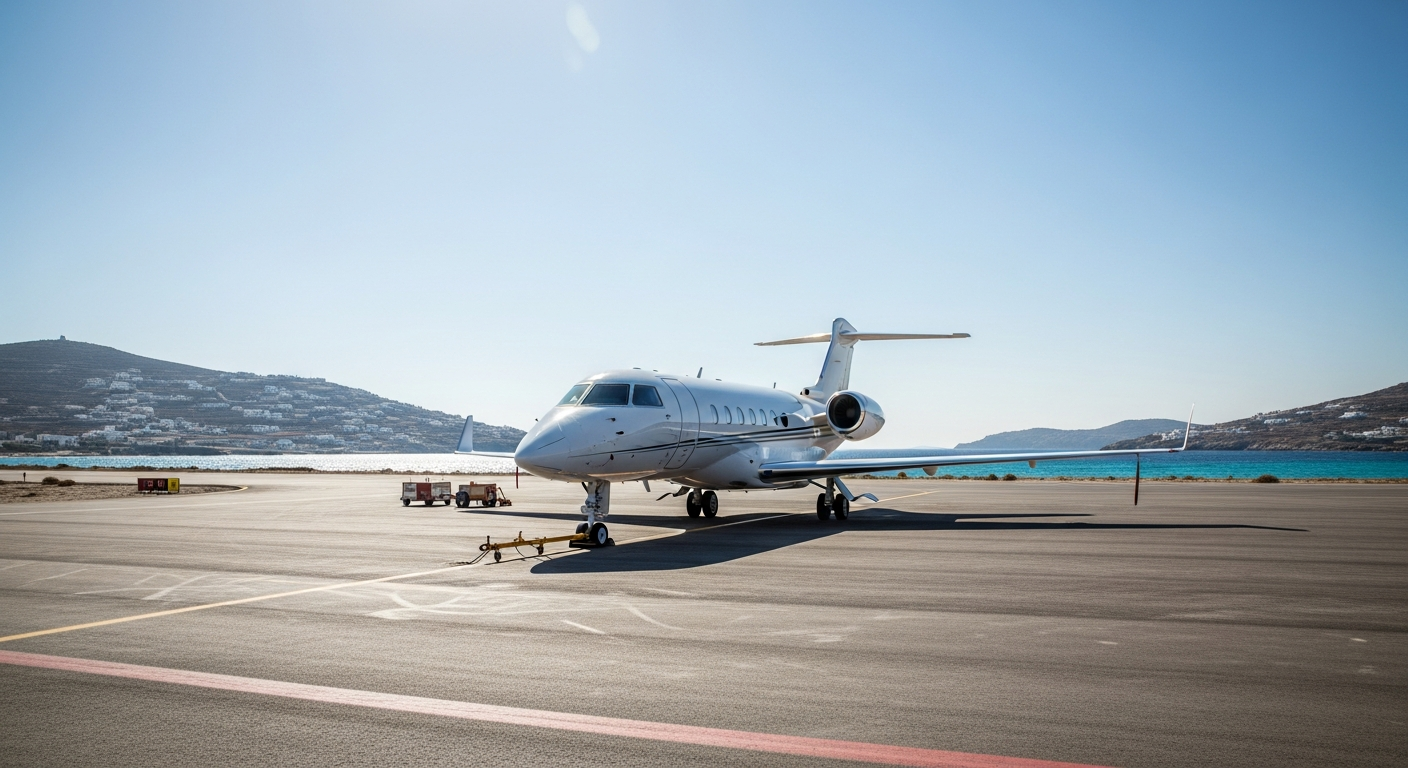
The Embraer Phenom 300E is the workhorse for this route: six passengers, a range of 2,010 nautical miles and a landing distance well within JTR's and JMK's limits even on a warm day with a full cabin. Its 1,700 kg baggage capacity comfortably covers a week's luggage for a family group, which matters more here than on shorter European hops.
Groups of eight or larger should look further up the fleet. The Cessna Citation Longitude, with eight to nine seats and a stand-up 6 ft 1 in cabin, or the Bombardier Challenger 350, seating up to ten with a genuinely flat-floor cabin, both operate into JTR and JMK without issue and give a larger party room to work or rest during the flight.
What does not belong on this route is anything at the ultra-long-range end of the market. The Bombardier Global 7500 and Gulfstream G650ER are both certified for runways well short of JTR's 2,125 metres on paper, but their typical landing weights on a Cyclades sector, combined with limited apron space for an aircraft of that footprint, mean most operators will not schedule them into Santorini during peak season regardless of the runway numbers. If a broker proposes a heavy jet for this route in August, ask why; the honest answer is usually that no lighter aircraft was available, not that it is the right tool for the job.
Cabin altitude is worth a mention too. The Phenom 300E holds a cabin altitude of 6,600 ft at its maximum operating altitude, noticeably more comfortable over a three-hour sector than an older-generation light jet running closer to 8,000 ft, which is a real consideration on a same-day return from London.
Timing It Right: Peak Season, August Gridlock, and the Best Days to Fly
Slot requests for JTR in the first three weeks of August should be filed at least eight weeks ahead; anything later risks a rejected PPR and an arrival diverted into Mykonos or Athens with a costly ground transfer to follow. Operators who fly this route regularly build that lead time into their standard quoting process, which is one reason a specialist broker outperforms a generalist one here.
Late June through mid-September is peak season across the Cyclades, with the final two weeks of August the most congested stretch of all. Both islands' hotel and villa occupancy run close to capacity, and airport slot rejections climb accordingly. May and the last ten days of September offer nearly identical weather with a fraction of the traffic, and charter rates typically drop by fifteen to twenty per cent as a result.
Midweek departures, Tuesday through Thursday, clear slot coordination more easily than Friday and Sunday, when leisure traffic from Athens, Northern Europe and the UK all converges on the same afternoon windows. A Sunday afternoon slot into JTR in August is close to the hardest booking on the entire Mediterranean charter calendar.
On price: a London-area departure, whether from Farnborough (EGLF) or Luton (EGGW), to Santorini on a Phenom 300E in peak August typically runs £14,000 to £19,000 one-way, depending on positioning costs and how close to departure the booking is confirmed. The same route in May or late September often comes in £3,000 to £4,000 lower, purely because demand and slot pressure both ease.
Island-Hopping Between Santorini and Mykonos: Jet, Helicopter, or Ferry
The flight between JTR and JMK takes roughly eighteen minutes in the air, though slot coordination and taxi time on both ends can stretch the full door-to-door journey closer to an hour. For clients splitting a week between the two islands, that short hop is usually worth booking as a standalone charter leg rather than trying to fold it into a single itinerary with the inbound flight.
Helicopter transfer is the other genuine option, run by a small number of Greek operators between the two islands, typically in the twenty to twenty-five minute range and without the airport slot dependency that governs fixed-wing traffic. It carries a premium over the equivalent jet hop but suits parties of four or fewer who want to skip the apron entirely.
The high-speed catamaran ferry between Santorini and Mykonos takes around two and a half hours in calm conditions, longer if the meltemi is running, and delays of thirty minutes to an hour are common in July and August as terminals struggle with volume. For a client who has already chosen a private jet to Santorini for the inbound leg, taking a public ferry for the inter-island hop undoes most of the schedule control the whole trip was designed to protect.
Insider Tips: FBO Handling, Villa Transfers, and Arrival Logistics
Santorini's general aviation apron holds only a handful of aircraft at once, and the ground handlers who work it can clear customs and baggage for a private arrival in under twenty minutes once chocks are in, with passports checked kerbside rather than in a terminal queue. Book handling in advance regardless; walk-up service during August is not guaranteed, and an unbooked aircraft can sit on the apron waiting for a handling slot of its own.
Villa transfers need the same lead time as the flight itself. Fira and Oia's road network narrows to single-lane traffic in places, and a car booked the day before arrival can mean a thirty-minute wait at the airport kerb while a driver navigates changeover-day gridlock in town. Confirm the transfer vehicle and driver contact details as part of the flight booking, not as an afterthought once wheels are down.
Baggage allowances on light and midsize jets are generous relative to cabin size, but golf clubs, dive equipment or anything oversized should be flagged to the operator before departure; JTR's baggage handling area is compact and unannounced oversized items can add real delay to disembarkation.
Finally, keep a buffer either side of the trip. Slot congestion, apron space and the sheer volume of August traffic mean that even a well-planned Cyclades charter benefits from a two-hour cushion built into any same-day connecting flight, whether that connection is in Athens, Zurich or back into London.