
Why New Year's Eve Is the Hardest Night of the Year to Fly Private
Slot requests for OMDB Dubai International on 31 December typically close to new applications by the first week of November, weeks before most travellers have even settled on a destination. The same pattern holds across every city that hosts a genuine countdown spectacle: Nice (LFMN), Geneva (LSGG) and Sydney (YSSY) all impose slot coordination on New Year's Eve that simply does not apply on an ordinary Tuesday in March.
The bottleneck is not the aircraft. Global charter fleets carry more than enough capacity to move clients on 31 December; the real constraint sits with ground handling capacity, FBO ramp space and, in several of the world's best countdown cities, curfews that were never designed with peak-night demand in mind. Sydney Airport enforces a curfew between 11pm and 6am for noise abatement, which means any aircraft not on the ground well before midnight is fighting for one of a shrinking number of pre-curfew arrival slots.
Hotel rooms follow the same pattern as the ramp. The handful of properties with genuine harbour, marina or piste-side fireworks views sell out for New Year's Eve as much as twelve months in advance in some cases, and certainly by early autumn in most others. A New Year's Eve private jet booking made in December is, in practice, competing not against other flights but against a room inventory that has already gone.
Ground handlers compound the problem. Signature Aviation and Universal Aviation both run reduced staff rotas over the festive period at exactly the moment demand peaks, and de-icing crews at Alpine fields are stretched thinnest on the days either side of the 31st. A request for overnight parking or a dawn de-icing slot submitted in mid-December arrives after the handler's own festive rota is already fixed.
That is why the useful charter conversation for NYE starts in September or October, not the week before Christmas: the aircraft is rarely the limiting factor, but the slot, the handler and the hotel room usually are.
The World's Best Countdown Destinations Reachable by Private Jet: Dubai, St Barts, Aspen, Courchevel, Sydney
Not every city marketing itself as a countdown destination can actually land a jet within a reasonable transfer of the party, and that narrows the realistic shortlist considerably.
Dubai remains the most straightforward of the five. The Burj Khalifa fireworks display draws clients into either OMDB Dubai International or the quieter Al Maktoum International (OMDW), with FBO slots at both fields effectively gone by mid-November for 31 December arrivals. A London to Dubai sector on a Gulfstream G650ER runs to roughly £75,000 to £95,000 one-way during NYE peak week, some 30 to 40 per cent above October pricing for the identical aircraft and crew.
St Barts is the destination most clients get wrong. Gustaf III Airport (SBH) has a runway of only 2,170 feet with a steep, obstructed approach that rules out jet traffic entirely; the standard routing lands at Princess Juliana International (TNCM) on St Maarten and continues by a twenty-minute ferry or helicopter transfer. Clients who assume they can fly a jet directly to the party lose weeks correcting the itinerary.
Aspen carries its own version of the same trap. Pitkin County Airport (KASE) sits at 7,820 feet, enforces a curfew between 10pm and 7am, and has so little overnight ramp space that many operators must reposition the aircraft to Eagle County (KEGE) or Rifle Garfield County (KRIL) rather than leave it parked at Aspen itself.
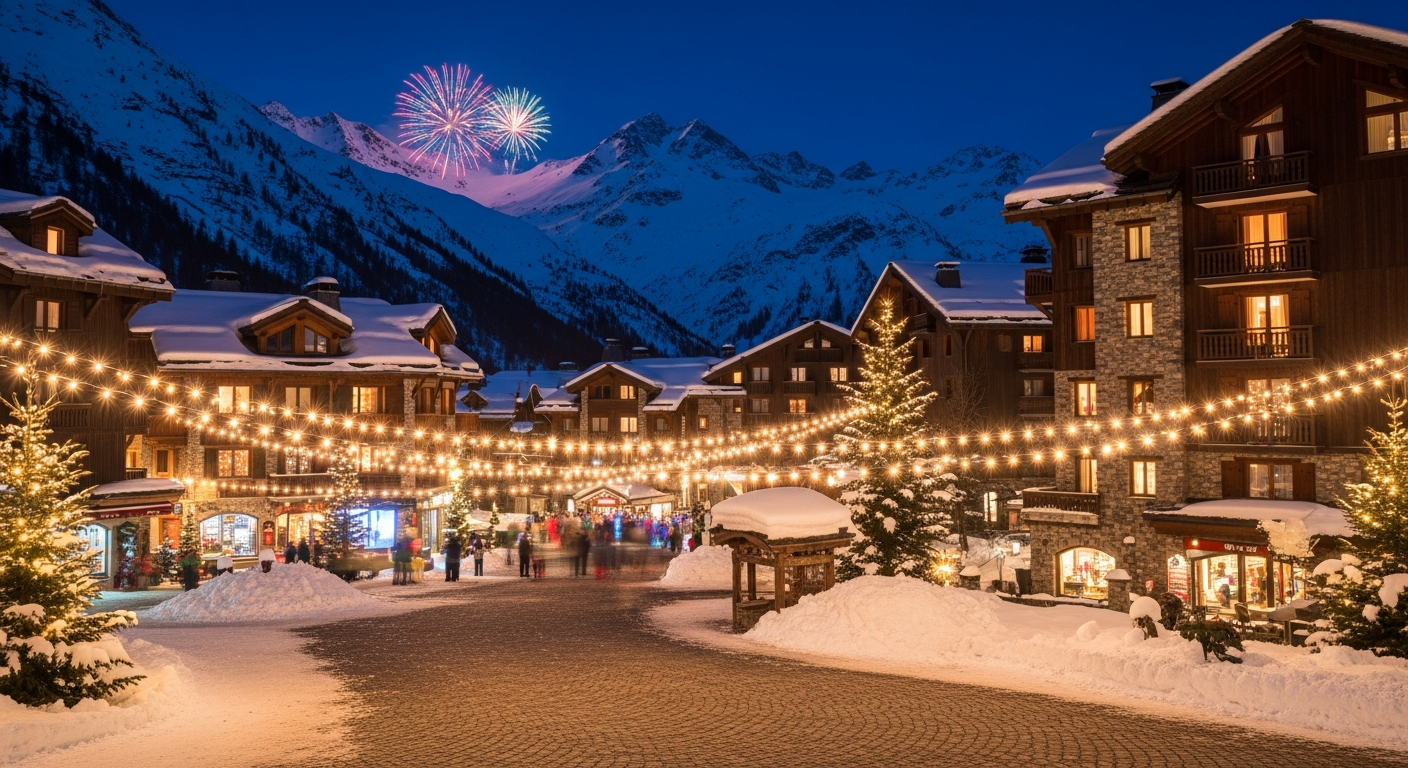
Courchevel's Altiport (LFLJ) is more extreme still: a 537-metre runway on an 18.5 per cent gradient that only specially certified pilots may fly. Almost every New Year's Eve private jet itinerary built around Courchevel lands instead at Chambéry (LFLB) or Geneva (LSGG) and completes the final leg by road or helicopter, a transfer of roughly ninety minutes to two hours depending on snow conditions.
Sydney closes the list with the most photogenic fireworks of the five and the least forgiving curfew. Aircraft need to be on the ground at Sydney Airport (YSSY) well ahead of the 11pm cutoff, since anything still airborne after that risks a diversion to Canberra or Newcastle on the one night nobody wants to explain a diversion.
When to Book: The Realistic Timeline for Securing NYE Slots and Aircraft
The realistic timeline for a New Year's Eve private jet charter starts in September, not December, because the slot coordination process at destinations like Dubai, Nice and Sydney runs on its own separate clock to the aircraft booking itself.
September is the right point to place a soft hold on both the aircraft and the destination airport slot. Operators can usually confirm aircraft availability within days, but the airport slot request itself, particularly at coordinated fields, can take several weeks to clear.
Early November is the hard deadline for most of the destinations covered here. Dubai's FBOs, Geneva's ramp allocation and Sydney's curfew-constrained arrival windows are all effectively locked by this point; requests submitted after early November are competing for cancellations rather than fresh capacity.
Early December is when ground handling and de-icing arrangements at Alpine and Nordic fields should be finalised, along with catering, crew hotel bookings and any customs pre-clearance paperwork for destinations outside the EU or UK. Leaving this stage until the second half of December routinely adds £1,500 to £3,000 in expedited handling fees on top of the base charter cost.
By mid-December, the only aircraft left on the busiest routes tend to be repositioning flights or last-minute cancellations, both of which come at a premium of 20 per cent or more over a booking secured in September.
Choosing the Right Aircraft for a Festive Group Departure
Group size, more than destination, is usually the deciding factor in which aircraft suits a New Year's Eve private jet departure, and it is worth working backwards from the guest list before falling in love with a specific tail number.
For a couple or a small family of up to six travelling to somewhere like Geneva or Nice, the Embraer Phenom 300E suits the sector well: a cabin height of 4 ft 11 in and a range of roughly 2,010 nautical miles cover most European NYE routes comfortably, at a London Farnborough (EGLF) to Geneva (LSGG) one-way charter cost of £14,000 to £22,000 during the peak period, against £9,000 to £13,000 in shoulder weeks on the same aircraft.
Groups of eight or more heading to the same Alpine cities should step up to the Citation Longitude or the Challenger 350, both of which offer a 6 ft cabin height against the Phenom's 4 ft 11 in and considerably more room for ski luggage and evening wear on the same trip. This is also where an NYE group charter starts to make sense financially per head, since the per-passenger cost of a Challenger 350 carrying eight can undercut two separate Phenom 300E charters carrying four apiece.
For the long-range legs, Dubai or Sydney from a UK departure point, the Bombardier Global 7500 and the Gulfstream G650ER are the two aircraft that make sense without a fuel stop; the Global 7500's 7,700 nautical mile range and 6 ft 2 in cabin height give it the edge on the Sydney sector, where non-stop capability removes an entire layer of scheduling risk on the one night that has none to spare. The Dassault Falcon 8X is worth considering on the Dubai sector too, since its three-engine configuration allows access into some Middle Eastern fields with restrictions a twin-engine aircraft would need to fly around.
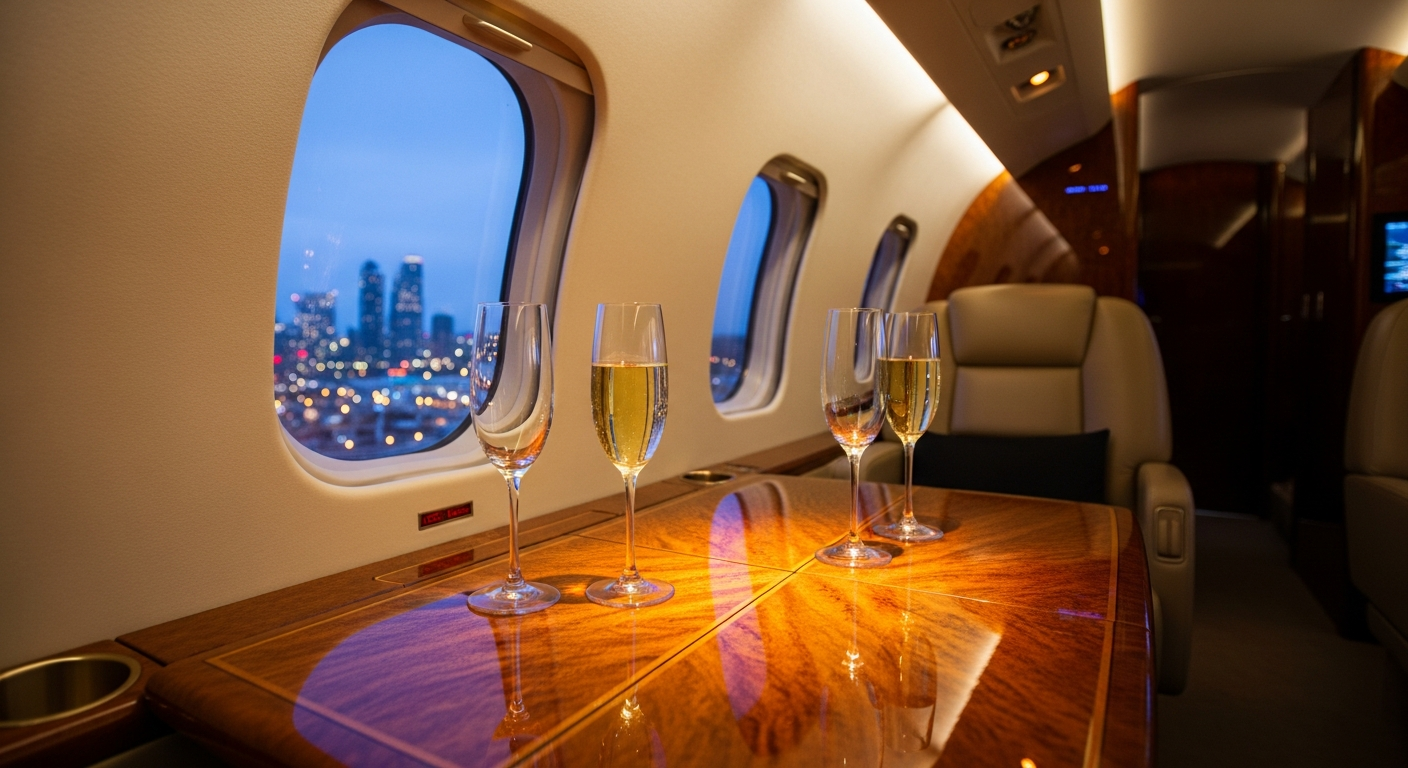
Catering deserves more planning attention on 31 December than on a typical charter. Caterers serving champagne and a proper dinner service need the order confirmed a minimum of 48 hours out over the festive period, against the usual same-day turnaround, and formalwear for a group of eight takes up more hold space than the equivalent ski kit, which is worth flagging to the operator when confirming baggage allowances.
Landing Slots, Curfews, and the Getaway: Flying Home Without the 1 January Bottleneck
Getting the outbound leg of a New Year's Eve private jet itinerary right is only half the job; the return is where the season's real congestion hits, because almost every client wants to fly home in the same forty-eight hour window.
The 1 to 3 January period sees a mirror image of the 31 December squeeze: the same slot-coordinated airports, the same limited FBO ramp space, now working in reverse as thousands of aircraft that arrived over the preceding week all try to depart within days of each other.
The fix is structural rather than tactical: build the return leg into the itinerary at the same time as the outbound booking, and consider flying home on 1 or 2 January rather than joining the 3 January exodus that every other charter client on the same route is also planning. A short repositioning to a secondary field, Chambéry instead of Geneva, or Newcastle instead of Sydney, can also open up slots that the primary airport no longer has.
Clients running a genuine multi-leg NYE trip, flying out for the party and on to a second destination before returning to the UK, should lock every sector of that itinerary in September alongside the outbound booking, since amending a multi-leg NYE routing in December means renegotiating slots at every airport in the chain rather than just one.
Crew duty time adds a further constraint that clients rarely anticipate. Duty hour limits apply over the festive period exactly as they would any other week, so a same-day there-and-back on 1 January, arriving Courchevel in the small hours and returning to London that afternoon, can run a single crew out of legal duty time before the return sector even boards. Operators typically resolve this by rostering a second crew or building in a rest period at the destination, both of which need agreeing at the point of booking rather than discovered on the day.
The brokers who earn their fee over this period are the ones tracking curfews, slot windows and FBO capacity months out, not the ones simply finding an aircraft that happens to be free on the day.