Why Touring Artists Charter: Show-Day Schedules, Curfews and Recovery Time
A 23:00 venue curfew in Cologne and a 09:00 load-in in Paris leave roughly ten hours in which an artist must travel, sleep and be vocally ready again. That arithmetic, not indulgence, is why headline acts treat a music tour private jet charter as part of the production budget.
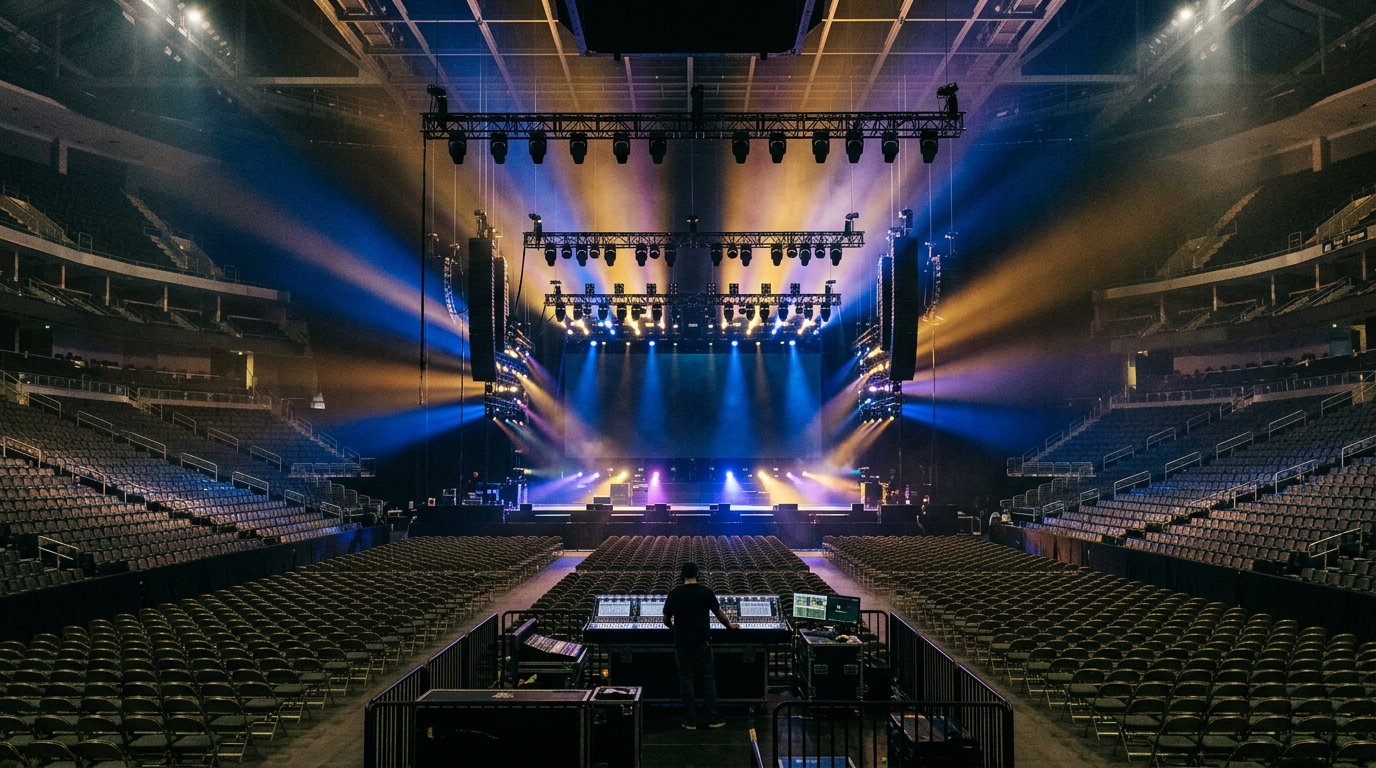
Show days are fixed points. Doors, soundcheck, set time and curfew are agreed months ahead, so the aircraft has to fit around them. A 22:30 finish, a 40-minute drive to the airport and a 90-minute flight put the artist in the next city shortly after 01:00, with a bed by 02:00.
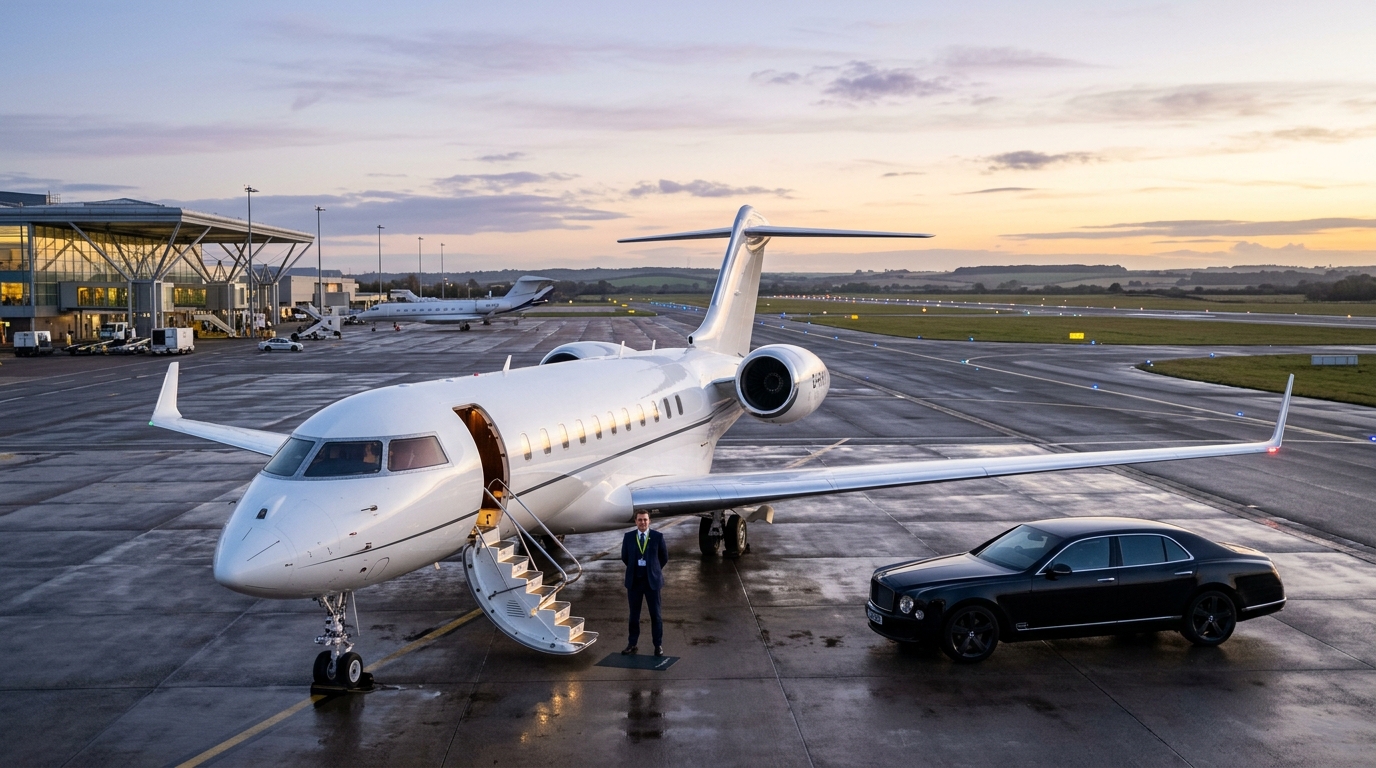
Recovery is the real product. A singer who loses sleep across a 20-date run will cancel or shorten sets, and a tour manager who protects eight hours in a hotel on show nights sees fewer of those losses. Boarding at an FBO such as Farnborough (EGLF) or Harrods Aviation at Stansted (EGSS) also removes the crowds and cameras that gather at public terminals.
Curfews cut both ways. Many airports restrict night movements, so the aircraft must depart before a quota or closing time, and pilots face duty limits of up to 13 hours for a daytime start, shorter after a night one. A broker plans the crew's duty clock alongside the artist's, because a crew that runs out of hours at 01:00 grounds the whole party.
Promoters benefit too. A team that knows the artist lands at 14:00 can book soundcheck for 16:00 rather than padding the schedule by half a day, and press and meet-and-greet slots can be fixed with confidence.
Building a Tour Routing: Sequencing Cities, Airports and Positioning Legs
Promoters sell dates by demand, not geography, so a run might read Madrid, Amsterdam, Milan, Stockholm, with 1,000 km or more between consecutive shows. The broker's first task is to pair each city with an airport the venue can reach within 45 minutes by road, such as LIML Linate, about 8 km from central Milan, or EHAM Schiphol for Amsterdam.
Next comes the positioning leg. An aircraft that drops the artist in Milan and then flies empty to its base bills those hours to the tour, while one that nightstops beside the artist costs only crew accommodation and parking. On a 20-city run, choosing which nights to stay put and which to return can shift the total by 10 to 15 flight hours.
Slots and permissions need the same attention. Some airports require prior permission for private movements, and busy FBOs run out of apron space on festival weekends. A sound routing names a primary and an alternate airport for every city; for London that means Farnborough first and Luton (EGGW), which operates around the clock, as the alternate.
Borders add their own timing. A UK to EU sector needs customs and immigration clearance at a staffed airport, and out-of-hours arrivals at 02:00 often require officers to be arranged in advance, at a fee. Equipment crossing borders needs an ATA carnet, and a missing stamp can hold a case for a day.
As a reference point, a Challenger 350 from London Luton to Berlin Brandenburg (EDDB), about one hour 45 minutes in the air, typically costs £11,000 to £15,000 one way at current market rates, before handling and any overnight positioning.

Choosing the Aircraft: Artist-Only, Full Band and Crew, and Splitting Across Two Jets
Cabin size should follow party size, not the artist's profile. For an artist with a manager, tour manager, security and a make-up artist, the Embraer Phenom 300E seats up to eight in typical charter layouts, but its cabin is 5 ft 1 in wide. The Bombardier Challenger 350 is 7 ft 2 in wide, 25 inches more, and 6 ft 0 in high; it seats nine and is the usual choice when the artist needs to sleep on a two-hour sector.
A full band with its core crew is a different problem: 12 to 14 people. The Dassault Falcon 8X, at 7 ft 8 in wide and 6 ft 2 in high, takes up to 14 in a typical charter layout. When the tour crosses oceans, the Bombardier Global 7500 and Gulfstream G650ER, whose 7,500 nm range covers London to Los Angeles non-stop, become the working choices.
Splitting across two aircraft is often smarter than one large jet. The artist and inner circle leave straight after the encore; a second jet carries the production team who leave after load-out at 02:00, or flies them ahead the day before. Above 14 passengers, or whenever two groups need different departure times, two aircraft are the sensible plan.
A party of ten on a nine-seat Challenger 350 needs either a Falcon 8X or a second jet, and for 20 or more an Airbus ACJ319 in a VIP layout, with a 12 ft 2 in cabin width, can carry the lot.
Splitting also hedges risk. If one aircraft develops a technical fault, the other can carry the artist and essential crew while the broker sources a replacement from the operator network. A single-aircraft tour has no such margin on a show day.
Cases, Instruments and Staging: Baggage, Hold Limits and Dangerous Goods
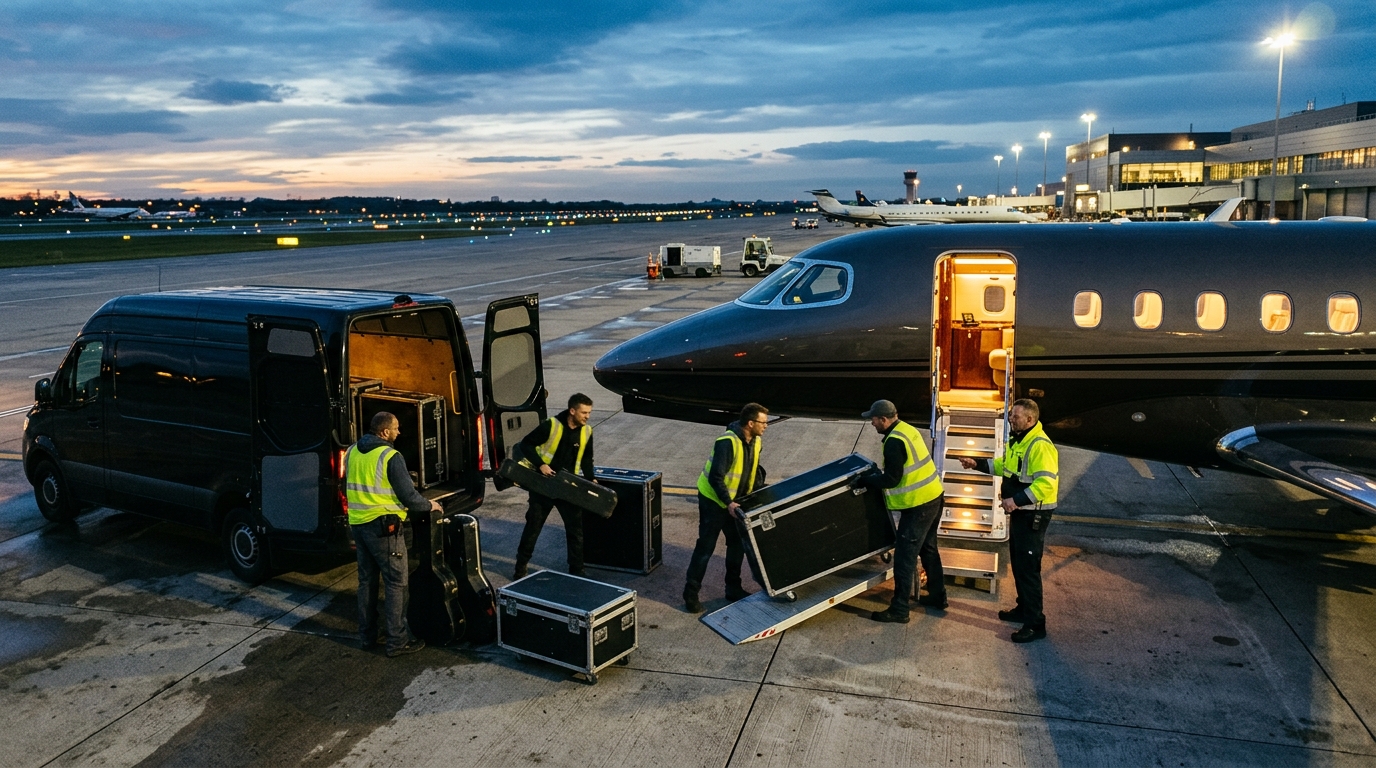
Baggage door dimensions, more than hold volume, decide what boards. A Phenom 300E offers 66 cu ft of baggage space, the Challenger 350 106 cu ft, the Falcon 8X 140 cu ft, and the Global 7500 and G650ER 195 cu ft. A 6 ft keyboard case or a rack-mounted mixing desk will not pass through the baggage doors of most midsize jets, so the broker needs the length, width, height and weight of each case before quoting.
Most tours therefore send backline and staging by truck or air freight, with the jet carrying personal items: guitars in hard cases, in-ear monitor kits, laptops, wardrobe and a DJ controller or two. Guitars normally travel in the cabin on a seat or in a closet, and that should be confirmed with the operator in advance, not at the steps.
Weight counts as much as volume. Passenger and baggage weight trade against fuel, so a Challenger 350 with nine passengers and heavy luggage cannot always fly its full range. A 1,500 km European sector is comfortable; a leg beyond about 2,000 nm may need a fuel stop.
Dangerous goods are where tours lose time. Spare lithium batteries between 100 Wh and 160 Wh need operator approval, anything above 160 Wh is refused, and loose cells must travel in the cabin, never the hold. Pyrotechnics, flash powder, confetti cannon cartridges, CO2 cryo canisters and generator fuel cannot be carried as baggage and must move with a licensed dangerous-goods freight forwarder.
Declare everything to the operator in writing before the first sector. A crew member who discovers an undeclared battery pack at the aircraft steps can refuse the flight, and the artist's departure goes with it.
Tour-Long Contracts vs One-Off Charters: Block Hours, Flexibility and Cost Control
Three structures cover most tours. A one-off charter is priced per sector at the market rate; a block-hour programme buys a fixed number of flight hours, commonly 25 to 100, at a locked hourly rate; and a tour-long contract reserves a named aircraft and crew for the whole run, with a daily availability fee plus flight hours.
Indicative figures help. A Challenger 350 typically runs to £4,500 to £6,000 per flight hour on a block basis, while a Falcon 8X sits nearer £8,000 to £10,000. A six-week run with 24 sectors of about 1.5 hours each is 36 flight hours, or roughly £160,000 to £215,000 on a Challenger 350 before availability fees and handling.
As a rule, once a tour passes eight sectors in six weeks, or 30 flight hours, a block programme or tour-long contract almost always beats booking sector by sector. It removes peak-season repricing and guarantees the aircraft is there.
One-off charters suit an artist with five dates and an uncertain schedule. Their weakness is availability on festival weekends in July, when midsize aircraft in Europe book out weeks ahead. Tour-long contracts trade flexibility for certainty, and cancelled shows may still incur availability fees, so the contract should set a notice period of at least 72 hours and a cap on unused days.
Keeping a 20-city run on schedule is operational work. A broker such as Villiers holds standby aircraft agreements in the region, runs a 24-hour operations desk and pre-files alternates, so that a venue change from Milan to Bologna, a storm at an airport or a customs delay becomes a re-timed sector rather than a cancelled show.
For management weighing how to book tour flying, the useful question for any broker is how fast a replacement aircraft can reach the artist. The answer should be measured in hours, not days.