
 Farnborough
 Nice
Nice
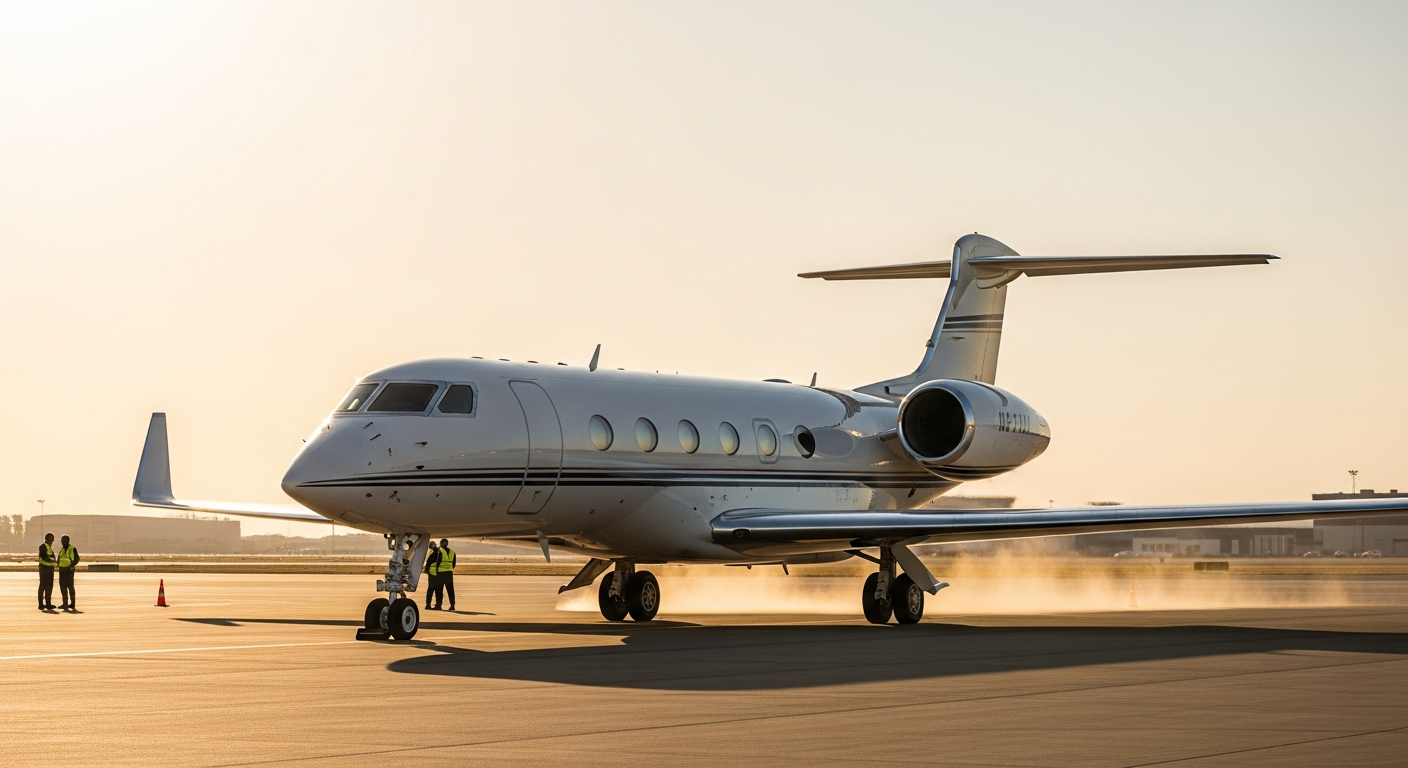
The End of an Era: What It Means That the G650 Is No Longer Being Built
Gulfstream handed over its last G650 airframe in the first quarter of 2025, and rather than softening demand, brokers report the used and charter-available pool tightening further in the months since. That is the opposite of what usually happens when a manufacturer closes a production line.
More than 500 G650 and G650ER airframes were delivered between 2012 and early 2025, and that number is now the entire universe of supply. No new options will be added to the fleet, no incremental year-model updates, no fresh allocation slots opening at the factory in Savannah. What exists today is what will exist for the working life of the type.
For a charter client, that fixed ceiling changes the calculation in a specific way. Aircraft still in active production tend to depreciate as newer variants arrive and undercut older ones on paper. A closed production run behaves differently: values hold, and well-maintained airframes with strong maintenance records become more sought after rather than less, because there is no replacement pipeline diluting demand.
It also means every operator and broker with access to a Gulfstream G650 on their certificate is defending a genuinely scarce asset. Where a Bombardier Global 7500 or a newer Gulfstream G700 will keep arriving in greater numbers over the coming decade, the G650 fleet only shrinks, aircraft by aircraft, as individual airframes retire from commercial service.
Production closure also draws a hard line under the specification. Every G650 and G650ER built shares the same cabin cross-section, the same Rolls-Royce BR725 engines, and the same PlaneView II flight deck, with only minor avionics and interior updates across the thirteen-year run rather than the generational leaps some competitor types have gone through. A client chartering any individual G650 today knows roughly what they are getting, without the variation in early versus late build standard that complicates buying decisions on aircraft still being updated year to year.
Inside the Cabin: Space, Altitude, and the Details Frequent Flyers Notice First
Step through the airstair and the floor plan opens into a cabin six feet five inches tall and eight feet six inches wide, dimensions that still outclass most of the large-cabin category more than a decade after certification. Passengers over six feet rarely need to duck.
The detail regular flyers mention first, though, is rarely the headroom. It is cabin altitude. At a cruise altitude of 41,000 feet, the G650 holds the cabin at roughly 3,000 feet, well below the 6,000 to 8,000 feet common on older large-cabin types. On a nine or ten-hour sector, that difference shows up directly in how fatigued passengers feel on arrival.
Sixteen oval windows, larger than the standard round cutouts on most competing airframes, keep the cabin bright without the glare problems smaller apertures can cause at altitude. Configurations typically seat 11 to 16 passengers, with some operators fitting a four-zone layout that separates a forward conference area from a rear stateroom with a berthing divan.
Cabin noise is the other quiet advantage. Gulfstream's acoustic treatment on the G650 keeps interior sound levels low enough that conversation at a normal volume carries the length of the cabin, which matters more than it sounds on a transatlantic sector where half the passengers are trying to work.
Baggage capacity rounds out the practical case: 195 cubic feet, accessible in flight through an internal door rather than only on the ground, which matters on longer trips when passengers want kit bags, golf clubs or extra luggage within reach without landing to retrieve them. Galley configurations vary by operator, but most G650s in charter service carry a full-height galley capable of serving proper meals rather than the reheated trays common on smaller cabin classes.

Range and Speed: Which Nonstop Routes the G650ER Actually Opens Up
London to Singapore nonstop is the routing that separates the G650ER from most of the rest of the charter fleet list, a sector of roughly 6,000 nautical miles that few large-cabin types can cover without a technical stop.
The standard Gulfstream G650 flies 7,000 nautical miles at Mach 0.85; the extended-range G650ER stretches that to 7,500 nautical miles, added through increased fuel capacity and a higher maximum take-off weight rather than any change to the airframe's external dimensions. Both variants share a maximum operating speed of Mach 0.925, which remains among the fastest cruise speeds of any purpose-built civilian jet.
In practical terms, the G650ER connects EGLL London to Hong Kong or Singapore nonstop with comfortable fuel reserves, and links New York to Tokyo on a single sector, a routing that historically required a fuel stop in Anchorage on less capable aircraft. Los Angeles to London is well within range with hours of reserve fuel remaining, and London to Perth becomes achievable with a minimal payload adjustment.
Speed compounds the range advantage on longer trips. A London to New York sector that takes roughly eight hours on a mid-size jet lands closer to six hours and forty minutes on a G650ER cruising near its top speed, a margin that matters most to clients making the return leg the same day.
That combination of range and speed also changes how many technical stops a routing needs, and every technical stop adds ground handling time, customs clearance and crew duty considerations that can push a same-day return outside legal limits. A Dassault Falcon 8X flying the same London to Singapore sector would typically need a fuel stop in the Gulf, adding ninety minutes to two hours to total journey time once descent, refuelling and departure sequencing are accounted for. The G650ER removes that stop entirely on most winter routings, and on many summer ones too, depending on payload and winds.

G650 vs G650ER vs G700: What's Really Different, and Does It Matter for Charter
The gap between the G650 and the G650ER is narrower than most buyers expect: an extra 500 nautical miles of range and a modest increase in maximum take-off weight, with identical cabin dimensions, identical Mach 0.925 top speed, and identical cockpit avionics. For charter purposes the two are close to interchangeable unless the specific mission needs that last 500 nautical miles.
The Gulfstream G700 is a different aircraft altogether. It shares the G650's basic design philosophy but stretches the fuselage to a cabin length of nearly 57 feet, adds a taller six foot three inch cabin height, and configures up to five distinct living areas including a dedicated crew rest suite, all built for the transpacific and ultra-long-haul missions the G650ER can only just reach. Range on the G700 matches the G650ER at 7,500 nautical miles, but the extra cabin volume is aimed squarely at clients flying twelve-hour-plus sectors with a full aircraft of passengers.
The Bombardier Global 7500 is the other direct comparator worth naming here, with a published range of 7,700 nautical miles, a six foot two inch cabin height, and its own four-zone layout including a permanent crew suite; it competes with both the G650ER and the G700 depending on mission length.
Does the extra cabin volume matter for a typical charter booking? For most groups of eight to fourteen passengers on sectors under ten hours, no. The G650ER's cabin comfortably serves that mission, and because so few G700s have entered the charter market since deliveries began in 2024, most owners are flying them privately rather than placing them on certificate. A Gulfstream G650 charter remains the more available, more proven option for the vast majority of large-cabin bookings today.
Booking a G650 Charter: Availability, Positioning, and What Drives the Price
Not every G650 in private hands is available to charter; a meaningful share sits on owner-only management contracts, which narrows the pool further than the total delivery count suggests. A handful of European operators hold G650s and G650ERs on their air operator's certificate, concentrated around EGLL, LFPB Paris Le Bourget and LSGG Geneva, and those bases largely determine where positioning costs run highest or lowest.
Because the fleet is fixed and scattered across relatively few operators, lead time matters more than it does with aircraft still in production. Booking six to eight weeks ahead for a peak-season transatlantic or long-haul sector gives a broker room to secure the right airframe rather than whatever happens to be nearest; booking inside a week for the same trip usually narrows the choice to whichever G650 is already positioned close by, often at a higher price.
Peak weeks make the scarcity more acute still. Around the Monaco Grand Prix, the Cannes Film Festival and the last fortnight of December, every G650 within range of southern Europe or the Alps tends to be committed days in advance, and brokers who wait until the week of travel are usually choosing between a significant positioning premium or a different aircraft type altogether.
Price itself is driven by four factors: the age and interior condition of the specific airframe, the distance the aircraft must be positioned before pick-up, the sector length, and seasonal demand. A London to New York one-way sector on a Gulfstream G650 typically runs £75,000 to £95,000 at current market rates, while a London to Singapore sector on the longer-legged G650ER moves into the £140,000 to £165,000 range once fuel stops are eliminated from the routing.
The clearest decision threshold for choosing a G650 over a newer type comes down to group size and sector length together: for eight to fourteen passengers flying beyond six hours, the G650ER's combination of cabin comfort, low cabin altitude and genuine nonstop range makes it the stronger booking than a mid-size jet with a technical stop, and it remains more readily available on charter certificate than the G700 that succeeded it. A broker who knows which operators actually hold G650 allocation, rather than simply which aircraft exist on paper, is the difference between landing a firm quote and chasing an aircraft that was never really available.