
 Farnborough
 Nice


What an Empty Leg Actually Costs the Operator: Fuel, Fees, Crew Hours and the Next Committed Sector
A Challenger 350 flying empty from Geneva (LSGG) to London Luton (EGGW) burns almost exactly the fuel it would burn with eight passengers aboard. The operator's cost on a repositioning sector is set by the aircraft's movement, not by who sits in the cabin.
The aircraft is on that route because a client's outbound trip ended in Geneva and the operator's next committed departure is from Luton. The operator has to move it either way. An empty leg is the unsold half of a journey that has already been paid for.
Fuel is the largest variable line. The Challenger 350 burns around 1,700 lb an hour, roughly 960 litres, and this sector takes about 1 hour 35 minutes block to block. At current into-plane prices that is £1,300 to £1,700. It is costed at actual block time, so a headwind or a holding pattern over Luton moves the figure.
Fees come next. Landing, parking and handling at EGGW typically run £1,500 to £2,500 for a midsize jet, with a further handling charge on departure from LSGG. These are cash costs the moment the wheels turn.
Crew hours are the constraint that never appears on an invoice. Under EASA rules a basic flight duty period tops out at 13 hours, and it shrinks with early starts, late finishes and extra sectors. A crew that has already flown a morning rotation may have only a few hours of duty left, which decides whether the reposition can wait for a buyer or must leave on schedule.
The fourth cost is the one operators weigh hardest: the next committed sector. If the Challenger 350 is due to carry a paying client out of Luton at 18:00, every minute of slippage on the reposition puts that revenue at risk. No buyer for the empty leg is worth that exposure.
Add the lines together and the cash cost of this sector sits near £3,500 to £4,500, against a standard one-way charter rate of £9,000 to £12,000. That gap is the operator's room to price, and the rest of this article keeps returning to it.
The Pricing Curve: Why the Floor Drops in the Final 72 Hours and Where It Stops
At 96 hours out, an operator can still hope to sell the Geneva to Luton sector at 70 to 80 per cent of the standard one-way rate; with 12 hours left, anything above the operator's floor is a good result.
The curve is not a discount schedule. It tracks the falling probability of a sale against a cost that does not change. Every hour that passes removes buyers whose plans cannot flex, so the expected value of waiting drops. That is what empty leg pricing really measures: the operator's estimate of how likely the aircraft is to sell at each price, set against one fixed floor.
In practice three bands appear. From seven days to 72 hours, operators hold near 70 to 80 per cent of the charter rate and wait for a buyer whose route matches. Between 72 and 24 hours the price falls fastest, to roughly 55 to 65 per cent, because the pool of clients who can still organise passengers, passports and ground transfers is shrinking. Inside 24 hours the price settles toward the floor.
The floor stops where the client starts to cost the operator money. Engine and maintenance reserves on a midsize jet run roughly £700 to £1,000 per flight hour, which adds about £1,100 to £1,600 over this sector. Passenger handling, customs and catering sit on top. Together with the £3,500 to £4,500 cash cost, that puts the practical floor at £4,800 to £5,800, about half the standard one-way rate.
Two things stop the fall. One is that floor. The other is the operator's refusal to risk the next committed sector, so a buyer who asks for a three-hour delay at the departure end gets no extra reduction, because that delay is simply not on offer.

Fleet Positioning in Real Time: How a Reposition Becomes Visible Before It Is Advertised
Positioning flights are commonly estimated to make up between a quarter and a third of all charter sectors, and for much of their life nobody outside the operator's operations room can see them.
The signal starts in the operator's schedule. When a trip is booked one-way, the aircraft's return is implied but unsold. A crew assignment, a flight-plan entry and a live ADS-B position showing the aircraft parked at LSGG, with its next committed departure at EGGW, are enough to infer a repositioning sector before anyone publishes it.
That inference is what villiersOS automates. The agent reads schedule data from operators, checks it against live aircraft positions, and holds each reposition as a priced, matchable option with a departure window and a falling price floor. A broker no longer waits for an operator to email a list of available aircraft; the sector is already modelled.
Operators will only trust the output if it carries their own constraints. Each option therefore includes the latest permitted departure time, the crew duty remaining and whether the aircraft may deviate from its planned route. Without those three fields, a visible leg is a rumour rather than something a client can book.
The same architecture could run in other sectors where inventory is perishable and repositions are common. A yacht moving from Antibes to Palma ahead of a committed booking is a close analogue, and the model applies equally to any asset that must travel empty between paid engagements. villiersOS does not operate in yacht charter today; that is where the agent model could generalise, not where it serves clients.
Matching a Client Route to a Moving Aircraft: Detour Distance, Alternate Airports and Crew Duty Limits
A client flying from Farnborough (EGLF) to Geneva on a Thursday may find the right aircraft leaving Luton instead, roughly 40 nm to the north-east.
Detour distance is the first filter. A midsize jet cruising near 430 knots covers about 105 nm in 15 minutes, so we treat any match needing more than 15 minutes of added track as non-viable. A pickup under 40 nm off the planned path is effectively free, because the extra fuel is a few hundred pounds.
Alternate airports widen the match. London offers EGGW, EGLF, Biggin Hill (EGKB) and Northolt (EGWU) within a short drive of each other. If the client can accept an airport within 60 minutes of their origin by road, the pool of aircraft whose path passes close enough grows several times over.
Crew duty is the hard limit. Adding a pickup at EGLF with 45 minutes of ground time draws on the same 13-hour basic duty period. A crew with nine hours remaining can absorb that stop and still reach Geneva; a crew with four hours left cannot, because the onward sector, turnaround and positioning home must all fit inside what remains.
Fixed-time departures bite last. If the aircraft must be at EGGW by 18:00 for its next committed sector, the client's usable window may be as narrow as 90 minutes. A buyer who needs to leave at 20:00 does not have a flexible leg; they have a conflict, and the system should reject the match rather than show it.
Reading an Empty Leg Quote Properly: What Is Fixed, What Can Move and When to Walk Away
A quote of £5,400 for a Challenger 350 from EGGW to LSGG looks simple, but part of that number is fixed and part is negotiable.
Fixed: the aircraft, the departure airport, the latest departure time and the price basis. Movable: departure within the operator's stated window, usually one to two hours at best; an alternate airport if the crew and route allow; and catering. Ask what the figure includes, because landing fees, handling, VAT and any de-icing are billed differently by different operators.
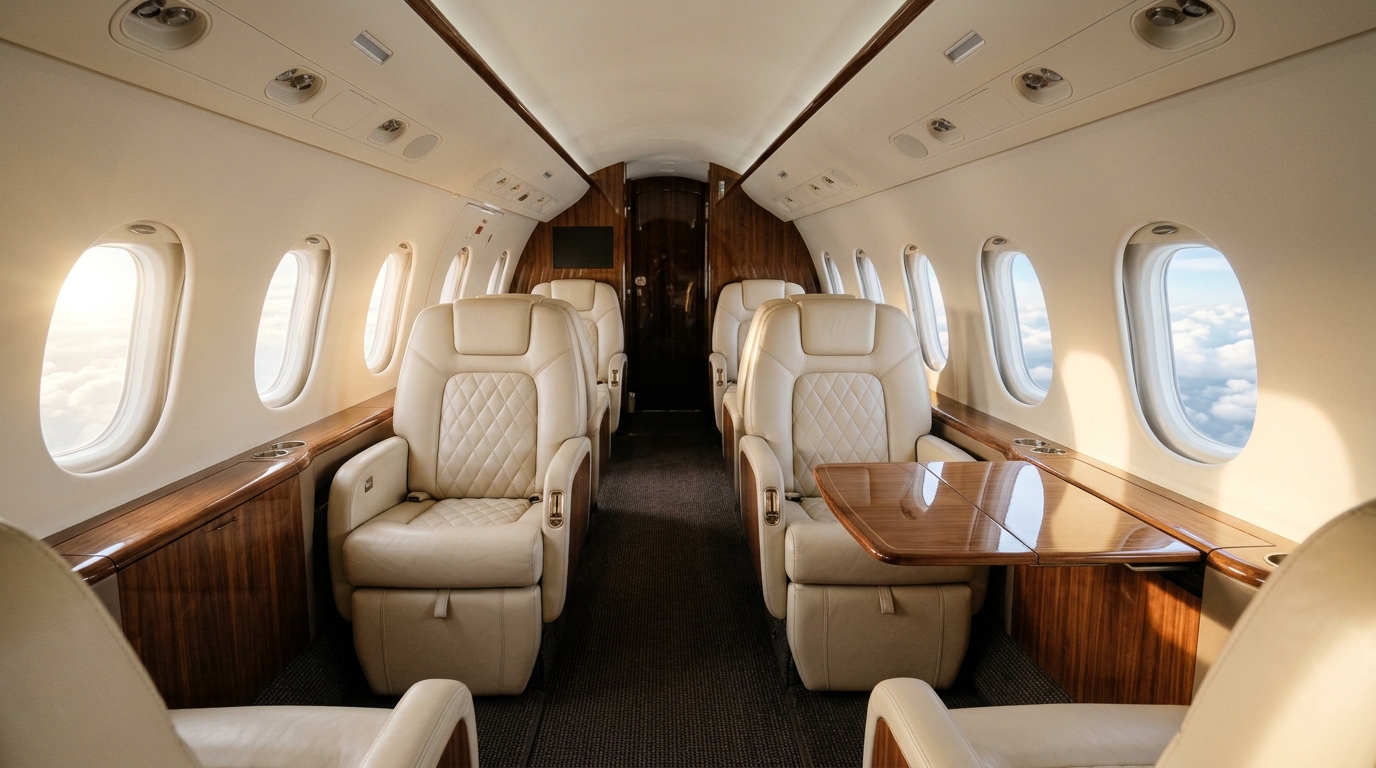
Check the aircraft too. The Challenger 350 offers a 7 ft 2 in wide, 6 ft high cabin; the Embraer Phenom 300E, a frequent reposition on shorter hops, measures 5 ft 1 in by 4 ft 11 in. A party of six with golf bags will find those two very different propositions, and the Citation Latitude, at 6 ft 5 in wide, sits between them.
Walk away in four cases. First, when the departure window offers less than two hours of flexibility and your plans have none. Second, when the quote exceeds roughly 70 per cent of the standard one-way rate with under 48 hours to go, since the curve should already have fallen. Third, when the operator will not put cancellation terms in writing, because a reassigned aircraft can cancel a repositioning sector at short notice. Fourth, when the detour pushes your arrival past an airport's operating hours.
What remains is a price built from known costs, a window set by crew and a committed next sector, and a route that either fits the aircraft's path or does not. A well-priced reposition sells because the numbers line up, and a quote you can trace back to those numbers is one worth accepting.