
 Farnborough
 Nice


Why the Quote and the Final Invoice Rarely Match: Block Time, Pass-Throughs and the Variance Clock
On a Challenger 350 flying Farnborough (EGLF) to Nice (LFMN) and back with one night on the ground, a quote of £26,680 can legitimately finish at £30,680 without anyone having made a mistake. That is a 15 percent gap, and it comes from four ordinary variances. Reconciling the final bill against the original quote is how a broker, an operator and a client establish which parts of that £4,000 were earned, which were pass-throughs and which need challenging.
Here is the worked example used throughout this article. The quote assumed 4.2 block hours at £5,400 an hour (£22,680), £1,500 for fuel and handling, £900 for landing and parking, and £1,600 for catering and crew costs. The final invoice shows 4.7 block hours (£25,380), £1,950 for fuel and handling, £1,200 for landing and parking, and £2,150 for catering and crew costs.
The variances are therefore +£2,700 on block time, +£450 on fuel and handling, +£300 on landing and parking, and +£550 on catering and crew. Block time carries two thirds of the gap, which is typical: it is the only line priced per hour and measured in tenths of an hour.
A quote is a forecast built from filed routings, published airport charges and the catering order as it stood three days before departure. An invoice is built from what happened: the holding pattern at Nice, the 40-minute wait for a stand, the extra case of wine added at the FBO. The variance clock starts when the wheels leave the ground, and it runs until the last third-party supplier invoice arrives. Handling agents and fuel suppliers often bill 10 to 30 days after the trip, so a final figure issued on day two is frequently an estimate dressed as a total.
A useful working rule is to classify every line on the quote as fixed, metered or estimated before the trip flies. Fixed lines, such as a negotiated positioning fee, should not move. Metered lines, chiefly block time, move with the trip sheet. Estimated lines, such as fuel uplift and third-party fees, move with supplier paper. That classification tells everyone in advance which gaps are expected and which are a question.
What the Operator Needs Reconciled: Trip Sheet Hours, Fuel Uplift, Handling and Landing Charges
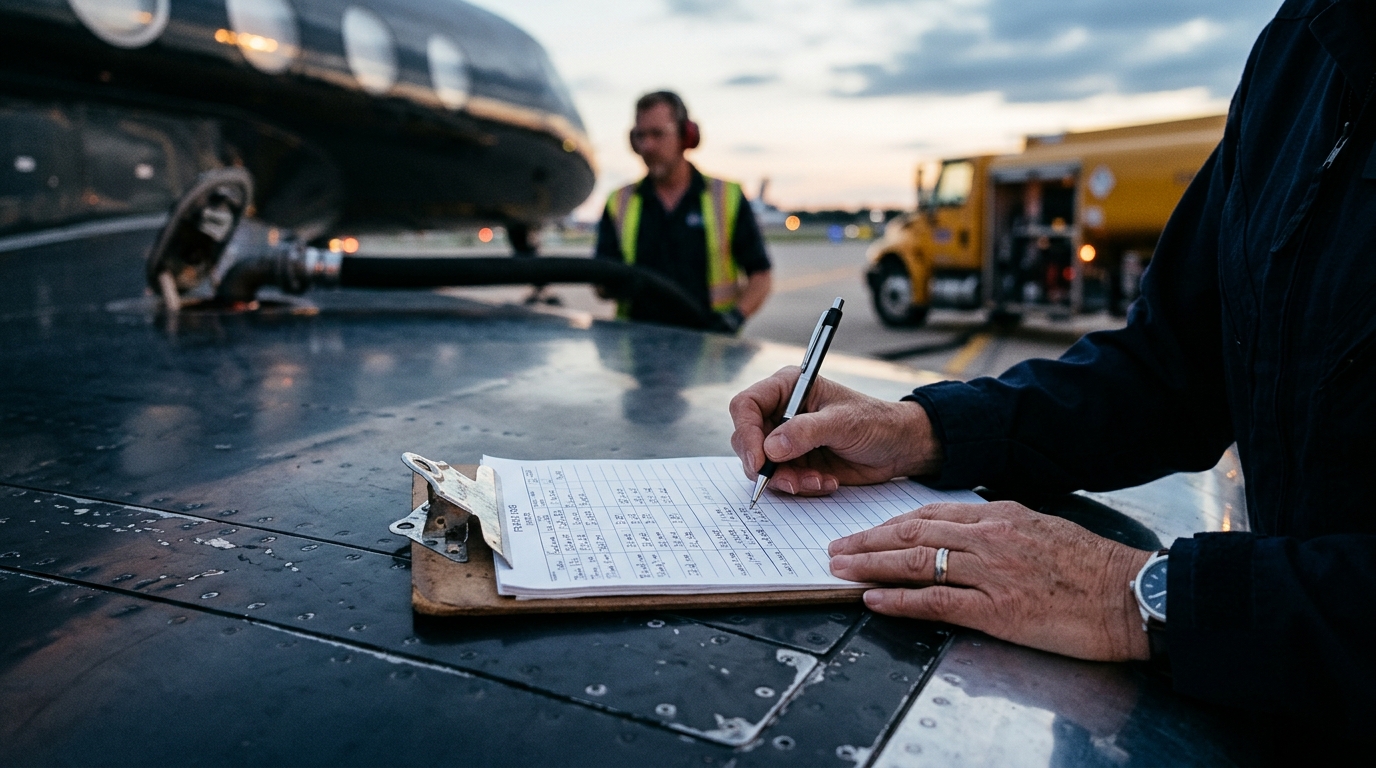
The operator's source of truth is the trip sheet, and every other document is checked against it. Block time runs from brakes released to brakes set, and the crew logs it in the aircraft's journey record. If the trip sheet says 4.7 hours and the quote said 4.2, the operator owes the broker a clear account of where the extra half hour went: taxi delays at EGLF, an ATC reroute, a missed slot at LFMN or a diversion.
Fuel is the second operator task. The uplift tickets show litres or US gallons taken, the price per unit and the supplier. A Challenger 350 typically burns roughly 1,400 to 1,600 lb of fuel per flight hour, so an extra 0.5 hours of block adds around 750 lb, and any price difference between the quoted and actual per-gallon rate multiplies across the full uplift. The operator matches ticket to invoice and confirms the aircraft was not tankering fuel for its own convenience, since that cost is not the client's to carry.
Handling and landing charges come from third parties: the FBO at Farnborough, the handling agent at Nice, the airport authority for landing and parking. Each issues its own paper, usually in euros for LFMN, and each is matched to the trip by tail number and date. Parking is the line that most often surprises, because a two-day stand at a congested Riviera airport is charged by the aircraft's maximum take-off weight and the hours on the apron.
The operator's own question is simple: does every pass-through on the broker invoice have a supplier document behind it, and does the document match the trip sheet's times? An operator that answers yes to both can defend the invoice line by line. One that cannot will find the dispute arrives months later, when the crew have moved on to other trips and nobody remembers why the aircraft sat on the apron.
What the Broker Needs Reconciled: Signed Contract, Commission Basis and the Margin Left After Variances
The broker reconciles against two documents the operator never sees in full: the contract the client signed and the commission arrangement with the operator. The signed contract defines what may be passed through and on what basis. It might say block time is billed at actual, capped at 10 percent over quoted hours, or that third-party fees are billed at cost with receipts on request. Those clauses decide whether the £4,000 variance can go to the client at all.
Commission is the second matter, and it is where the margin arithmetic turns unforgiving. Suppose the broker's margin on the quote is 8 percent, or £2,134 on £26,680. If the contract allows the variance to pass through at cost, the pound margin stays at £2,134 but the percentage falls to 7.0 percent of the £30,680 invoice. If the broker instead absorbs the variance because the contract was silent or the client refuses it, the margin of £2,134 becomes a loss of £1,866 on a single rotation.
That asymmetry is why brokers track the margin remaining after variances, not just the margin quoted. A broker running 40 trips a month at an average quote of £26,680 handles roughly £1.07 million of monthly turnover. A 15 percent variance that is absorbed even on one trip in five puts about £32,000 of exposure into a month that was budgeted on 8 percent margins.
The broker also holds the timing risk. Payment to the operator is often due within days of the trip, while a handling agent's invoice may arrive a fortnight later. Good practice is to issue the client invoice in two stages when the contract permits: an estimate-based balance after the trip, and a short supplementary invoice once the final supplier paper has been matched. Neither stage should be issued without every pass-through traced to a supplier document or a trip sheet entry.

What the Client Needs Reconciled: Line-by-Line Against the Quote They Signed, VAT and Currency Included
The client holds one document that matters above all others: the quote they signed. A principal's office or family office will open the final invoice beside that quote and read down both columns. If the lines have been renamed, merged or reordered, the comparison becomes harder than it should be, and goodwill erodes faster than money does.
The client's questions are narrow. Is each line on the invoice a line that was on the quote? Where it moved, is the movement explained by a document, such as a trip sheet extract showing 4.7 block hours or a handling invoice from Nice? Is the unit rate unchanged? In the example, the hourly rate of £5,400 is identical on both documents; only the quantity moved, and that is the clean explanation the client wants.
Currency is the quiet source of discrepancy. Nice landing and handling fees arrive in euros, and the quote converted them at a rate fixed days before departure. If sterling moved by 2 percent against the euro in between, a €1,400 landing fee changes by about £25, a trivial figure that nonetheless produces an invoice line which cannot be explained without the conversion rate and date. Showing both the original currency amount and the rate applied removes the question before it is asked.
VAT treatment needs the same visibility. Whether a leg is zero-rated, standard-rated or outside scope depends on the route, the aircraft, the operator's establishment and the passenger's circumstances, and the position can differ between the outbound and return legs. A final invoice should state the treatment for each line, not only a single VAT total, so the client's finance team can check it against what the quote assumed. Where the treatment has changed, the reason should be written on the invoice itself.
Where Automation Genuinely Helps (and the Disputes That Still Need a Person): Matching, Flagging and Tolerance Rules
The three reconciliations above share a structure: take a document from one party, find its counterpart in another party's paper, and compare. That is what software does well. A system running villiersOS-style agents can read the trip sheet, the handling invoices and the signed quote, pair each line by category, tail number and date, and compute the variance on all four lines in seconds. For a team doing charter invoice reconciliation on dozens of trips a month, that matching step is the part that disappears first.
Flagging works the same way. A tolerance rule can be stated plainly: pass through block-time variances up to 0.3 hours automatically, flag anything beyond 0.3 hours or £500 per line, and always flag any line that has no supplier document behind it. In the example, the +£2,700 block variance, the +£450 fuel and handling and the +£550 catering lines all trip a flag, while the +£300 parking difference passes quietly. The person reviewing sees three lines with context, not a 40-line invoice.
Currency and VAT are the third area where automation earns its place. Applying the euro rate recorded on the quote date, checking that the VAT code on each line matches the route and the signed terms, and producing a client-ready statement showing original amounts and rates are mechanical tasks with right answers. Errors here are rarely dramatic, but they are the ones that make a client's finance team distrust every other number on the page.
What automation should not do is decide the disputes. A delay of 35 minutes at Nice might be an ATC slot restriction, which is no one's fault and usually passes through, or a late crew arrival, which the operator may be expected to absorb. A catering fee might be waivable as a goodwill gesture to a client who flies four times a year. A parking charge might be reduced because the broker knows the FBO manager. Each of those is a judgement about a relationship, a precedent or a reading of the contract, and the system's job is to present the evidence and the options, with the decision logged against a named person.
The same pattern would carry across to other charter products. The same architecture could run advance provisioning allowance reconciliation on a yacht charter, where the allowance is typically 20 to 30 percent of the charter fee and is settled against receipts at the end of the voyage. The matching and tolerance logic is identical; only the documents change.
For a broker, the practical test is whether every variance on a closed trip can be traced to a document and a decision. If the answer is yes, a £4,000 gap on a £26,680 quote is an explained invoice rather than a dispute.