
Naples Capodichino vs Salerno Costa d'Amalfi: Which Airport Actually Gets You There Faster
LIRI, the ICAO code for Salerno Costa d'Amalfi, only began clearing business jet arrivals in 2023, once the runway extension to 2,200 metres was finally certified for commercial and private traffic. Before that date, every Amalfi Coast private jet itinerary funnelled through Naples Capodichino (LIRN, NAP), regardless of where on the coast the client was actually headed. That single infrastructure change is why routing now deserves real thought rather than default habit.
Naples Capodichino remains the busier field, with a 2,628 metre runway, full customs and immigration facilities, and considerably more slot availability during peak Mediterranean season. It sits roughly 65 kilometres from Positano, and the coastal drive down the SS163 can run anywhere from 90 minutes to well over two hours once June traffic builds on the cliff road.
Salerno Costa d'Amalfi sits at the coast's eastern end, and that geography changes the calculation for anyone bound for Amalfi, Ravello, or Minori. The drive from LIRI to Amalfi town runs about 25 kilometres and 40 to 50 minutes; to Ravello, add another 15 minutes for the climb up the switchbacks.
The trade-off is capacity. Salerno's FBO handles a fraction of Capodichino's daily movements, and slot requests inside 24 hours are routinely declined during August. A broker booking an Amalfi Coast private jet arrival for late July needs that request in at least a week out, ideally longer for a Friday or Saturday landing.
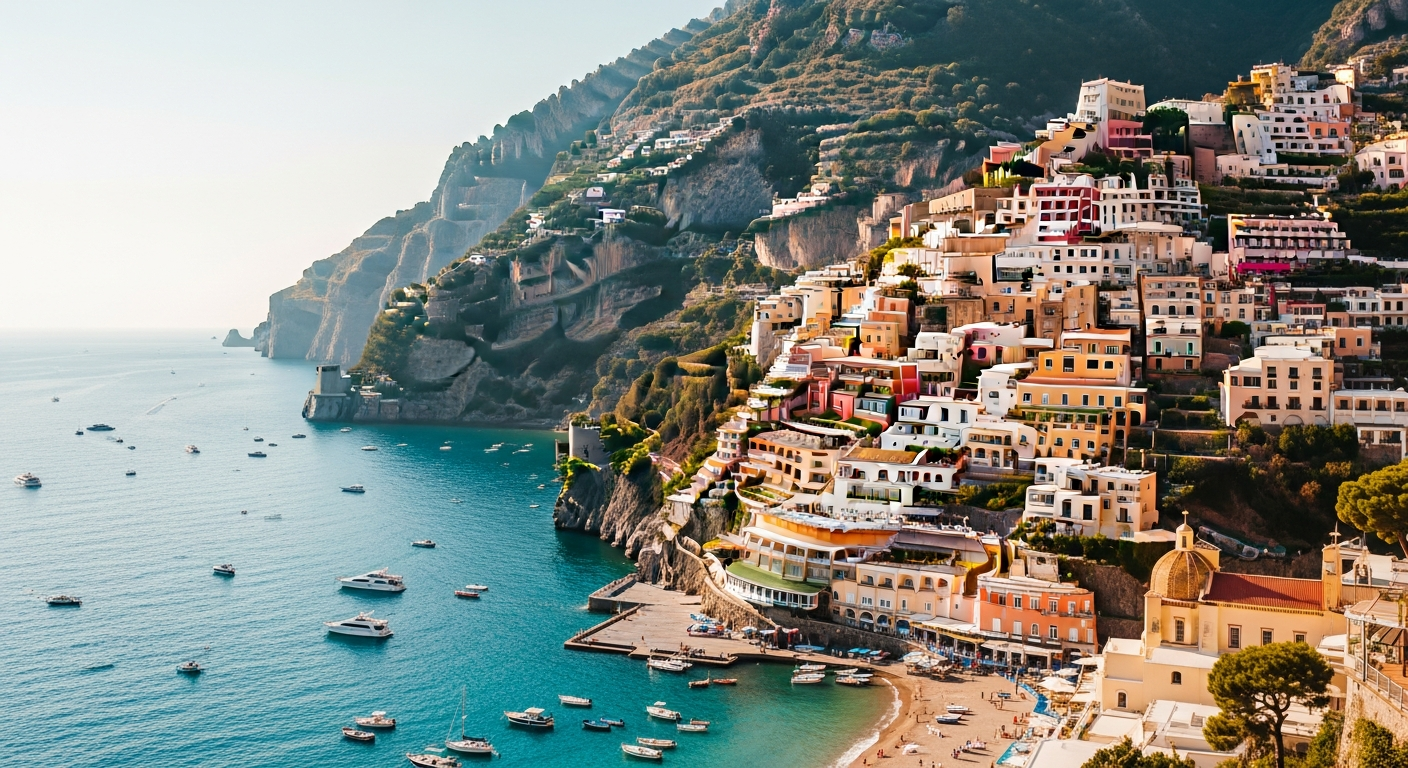
For Positano specifically, neither airport is genuinely close, which is precisely why so many operators default to Naples out of habit and then discover the drive eats the golden-hour arrival the client actually paid for. Salerno to Positano covers roughly 35 kilometres of coastal road and can add 45 minutes over the direct-line distance once summer traffic backs up around Praiano. The honest comparison: Naples wins for groups continuing to Sorrento or the islands by boat; Salerno wins for anyone whose final stop sits east of Positano.
The Final Leg: Helicopter Transfers into Capri, Positano, and Ravello
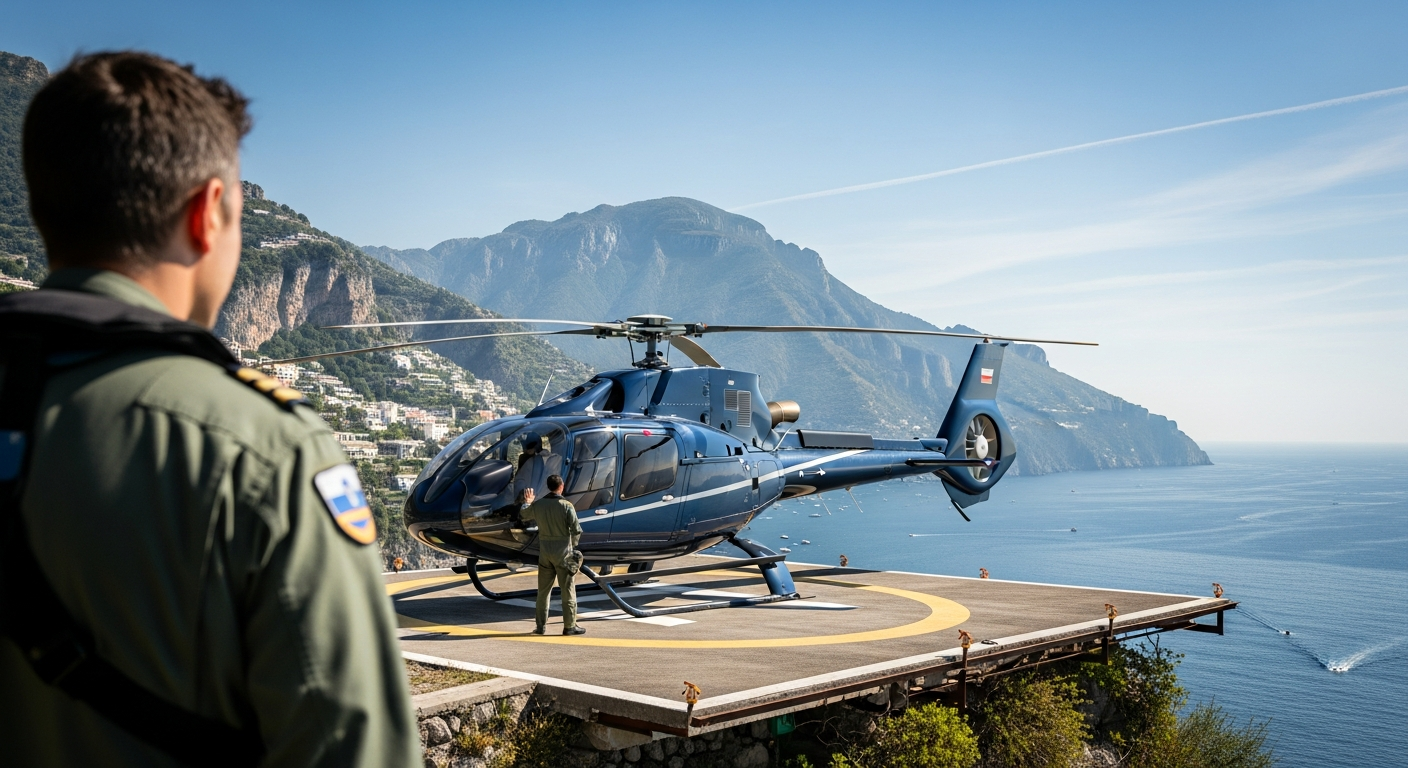
Capri's helipad, tucked above Anacapri, cuts the final segment to under 15 minutes from either Naples or Salerno, and it is the single detail that separates a broker who has actually run this route from one reading a map. Landing slots there are restricted and weather-sensitive; strong Libeccio winds off the Tyrrhenian close the pad more often in October than clients expect from an island this far south.
Positano has no public helipad, so the "helicopter transfer" most agents advertise is actually a helicopter into Capri or a private pad near Praiano, followed by a 20 to 30 minute boat transfer arranged separately. Anyone quoting a direct chopper-to-Positano-hotel-lawn service is either overselling a rare private-estate arrangement or simply wrong about what is operationally available.
Ravello sits high enough above the coast that a helicopter genuinely earns its cost. The alternative is an hour or more by road from either airport in season traffic, against a 12 to 15 minute flight from Salerno. For a client with a dinner reservation at a fixed hour, that difference is the entire point of paying for the transfer.
Booking a helicopter for the Amalfi Coast private jet passenger works best as a fixed package agreed before the jet departs the UK, not a same-day arrangement handled on arrival. Operators serving this corridor typically want 48 hours' notice in July and August, and same-day requests carry a real risk of falling back to a car and driver instead.
When to Fly: Reading the Amalfi Season from May Shoulder to September Peak
May delivers the same coastline at roughly 40 percent of August's hotel rates, with Capodichino slots still readily available inside a week of the requested date. Sea temperatures sit around 19 degrees, cool enough that swimming is a personal choice rather than a given, but the towns are uncrowded and restaurant tables in Positano and Ravello are bookable on two days' notice rather than two months.
June through early July is the genuine sweet spot: warm water, long daylight for a late helicopter transfer into Capri, and slot pressure at both airports that is manageable if booked two to three weeks out. This is also when most Amalfi Coast private jet enquiries at Villiers start converging on the same narrow window, so aircraft availability on a Friday afternoon departure from London tightens noticeably by late May.
August is a different proposition entirely. Salerno's FBO runs at its lowest slack of the year, weekend positioning into Naples can mean holding patterns during the Saturday morning rush, and hotel rates along the coast typically run two to three times the June figure. Anyone flying private specifically to skip the crowds is better served booking the last two weeks of September, when temperatures still sit in the mid-20s but the roads and restaurant bookings ease considerably.
September through early October rewards travellers willing to trade a few degrees of sea warmth for empty tables at Le Sirenuse and genuinely available slots at both LIRN and LIRI. It is, in practical terms, the best value window of the entire season for anyone prioritising the experience over the calendar photo.

Which Aircraft Makes Sense for the Route from London, Paris, and Geneva
Geneva to Naples covers roughly 460 nautical miles, a sector the Embraer Phenom 300E handles nonstop in around 1 hour 20 minutes with room to spare on its 2,010 nautical mile range, making it the natural choice for a party of up to six travelling light. From Paris Le Bourget (LFPB), the same aircraft covers the 650 nautical mile sector to Naples in roughly 1 hour 45 minutes.
London adds real distance: EGLL or EGLF to Naples runs approximately 830 nautical miles, comfortably within Phenom 300E range but tight enough on cabin time that groups of seven or eight are better served stepping up to a Bombardier Challenger 350, which carries up to ten passengers over a 3,200 nautical mile range and covers the London-Naples sector in roughly 2 hours 10 minutes with meaningfully more room to stretch out.
For parties who want to continue on to Sicily or the Aeolian Islands after landing, the Cessna Citation Longitude is worth specifying: its 3,500 nautical mile range and 6 ft 3 in cabin cross-section give it genuine range and comfort margin the Phenom 300E cannot match, at the cost of a materially higher hourly rate.
Runway length rules out very little on this route; both Naples and Salerno accept aircraft up to and including the Challenger 350 without restriction, though a heavy long-range jet such as a Bombardier Global 7500 is simply unnecessary cabin and cost for a sector this short and is rarely the sensible choice here.
On price: a London Farnborough (EGLF) to Naples Capodichino (LIRN) charter on a Phenom 300E typically runs £13,000 to £17,000 one-way, rising to £19,000 to £24,000 on a Challenger 350 depending on positioning and lead time. From Geneva, the same Phenom 300E sector to Naples runs closer to £9,000 to £12,000 given the shorter distance.
Where to Land, Stay, and Be Seen: A Broker's Black Book for the Coast
Le Sirenuse in Positano remains the address that defines the coast for most first-time visitors, and its position directly above the harbour makes a Capri helicopter transfer, followed by a short boat crossing, the smoothest way to arrive without a bag ever touching a car boot. Book the corner suites at least four months out for a July or August stay.
Ravello offers a genuinely different register: Belmond Hotel Caruso and Palazzo Avino both sit high enough above the water that a helicopter transfer from Salerno is not an indulgence so much as the only sensible way to arrive with the view intact rather than an hour of switchback driving behind you. Villa Cimbrone's gardens, a short walk from either hotel, are worth the detour even on a single-night stopover.
Capri itself rewards a slower arrival. JK Place Capri and the Grand Hotel Quisisana anchor the town's social centre, and a private jet passenger who has flown into Naples or Salerno and taken the helicopter direct to the island's helipad can be at a table at Da Paolino under the lemon trees within the hour, rather than mid-afternoon after a ferry queue.
The case for an Amalfi Coast private jet routing over a self-driven arrival from Naples comes down to time saved on arrival day and departure day combined, roughly three to four hours each way once helicopter transfers replace coastal traffic. On a week-long stay, that recovers most of a full day, time most of Villiers' clients would rather spend on the water than in a taxi queue.
Amalfi town itself, often overlooked in favour of Positano and Ravello, is worth a lunch stop at La Caravella for anyone landing at Salerno; at 25 kilometres and under an hour from the runway, it is the closest genuine town on the coast to LIRI, and considerably less crowded than its more photographed neighbours in peak season.