 Farnborough
 Nice
Nice
What Is the Embraer Praetor 600? Category, Origin, and Where It Sits in the Fleet
At 4,018 nautical miles of certified range, the Embraer Praetor 600 private jet can depart Farnborough (EGLF) and land nonstop at New York Teterboro (KTEB): a routing that most aircraft in its charter price bracket cannot complete without a fuel stop, and one that has fundamentally repositioned super-midsize as a category in the minds of experienced long-haul charter clients.
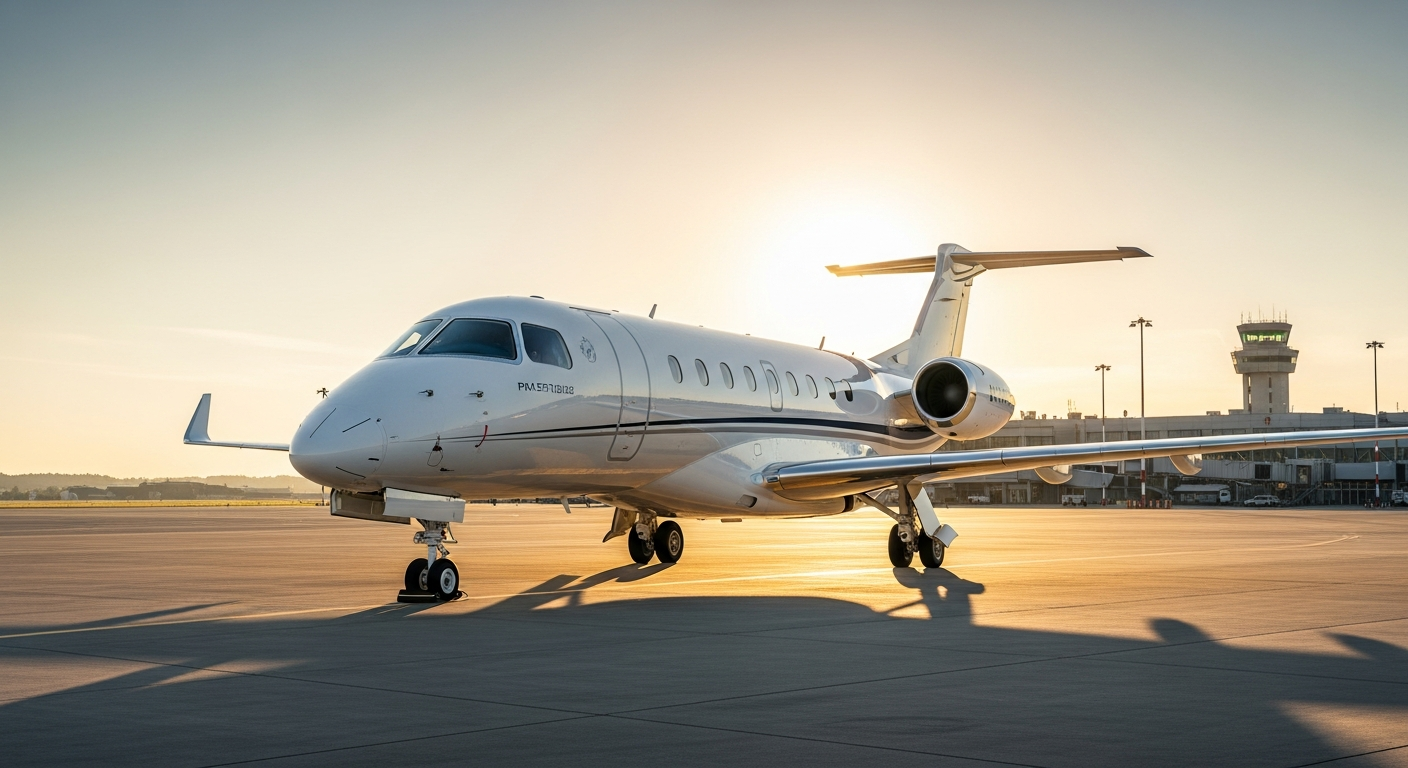
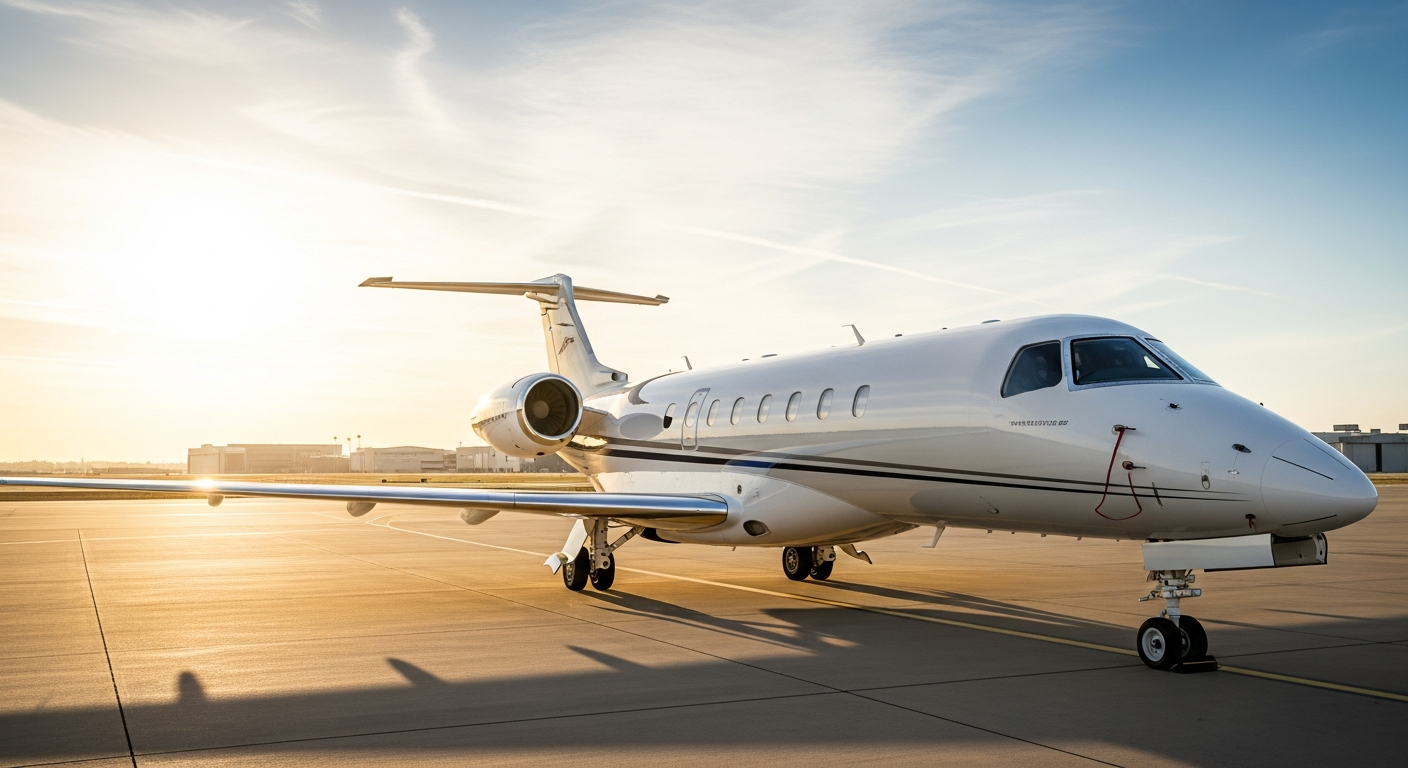
Embraer, the São Paulo-based manufacturer responsible for the E-Jets regional fleet and the widely chartered Phenom 300E, launched the Praetor 600 at NBAA 2018 and began operator deliveries in 2020. It represents the apex of the Legacy 500 platform lineage: a fuselage refined through successive generations, arriving in its current form with upgraded Honeywell HTF7500E turbofan engines, revised winglets tuned for high-altitude aerodynamic efficiency, and an interior redesigned to meet the expectations of clients who typically charter in the heavy-jet bracket.
Super-midsize positioning places the Praetor 600 clearly above light-jet platforms such as the Citation CJ4 and Phenom 300E, and below large-cabin heavy jets including the Gulfstream G500, Bombardier Global 5500, and Dassault Falcon 2000LXS. Its direct charter competitors are the Cessna Citation Longitude and the Bombardier Challenger 350. Both address a similar passenger count and operating cost bracket; neither matches the Praetor 600's certified range, and that single metric drives a disproportionate share of the aircraft's charter appeal.
Standard configuration seats nine passengers in a forward four-seat club and an aft section comprising individual seats and a flat-bed-capable divan. Some operators configure the cabin for eleven seats, but nine passengers on a longer sector is the arrangement where comfort and operational range most naturally align.
Range and Performance: The Routes This Aircraft Can Actually Fly Nonstop
Departing EGLF, the Praetor 600 covers the approximately 3,430 nautical miles to New York Teterboro (KTEB) nonstop on standard NBAA IFR reserves. Westbound block time runs to approximately seven hours and forty-five minutes; eastbound, on a favourable jet stream, the same sector regularly comes in under six and a half hours.
That single routing defines the aircraft's commercial case more clearly than any specification sheet. The Bombardier Challenger 350 has a certified range of approximately 3,200 nautical miles; the Cessna Citation Longitude reaches around 3,500 nautical miles. Neither covers EGLF to KTEB nonstop on consistent operational reserves. The Praetor 600 does, routinely, across all seasons and at standard maximum passenger load.
Within Europe and across Gulf routings, the arithmetic is equally straightforward. London to Dubai (OMDB) sits at approximately 2,990 nautical miles, covered nonstop in approximately six hours and fifteen minutes eastbound. Farnborough to Riyadh (OERK) runs to 2,850 nautical miles, well within the aircraft's range with no fuel consideration. For clients based in the UK and regularly routing to Gulf capitals, this eliminates the technical stop at Cairo, Larnaca, or Amman that a lighter super-midsize aircraft would require.
The Honeywell HTF7500E engines produce 7,528 lbf of thrust each and push the aircraft to a maximum cruise of Mach 0.82, approximately 470 knots true airspeed at FL410. A certified ceiling of FL450 places the Praetor 600 consistently above the weather systems and air traffic congestion that force lower-altitude jets into detours and extended fuel burns.
Where the range argument reaches its limit is on genuinely ultra-long sectors. London to Johannesburg (FAOR) at approximately 5,020 nautical miles, or London to Singapore (WSSS) at over 6,600 nautical miles, both require a heavy jet. The Dassault Falcon 8X, Gulfstream G650ER, and Bombardier Global 7500 cover those routings nonstop; for clients whose primary sectors stay within the Atlantic basin, the Gulf, and the longer European circuits, that ceiling rarely applies.
Inside the Cabin: Stand-Up Height, Noise Levels, and Passenger Experience
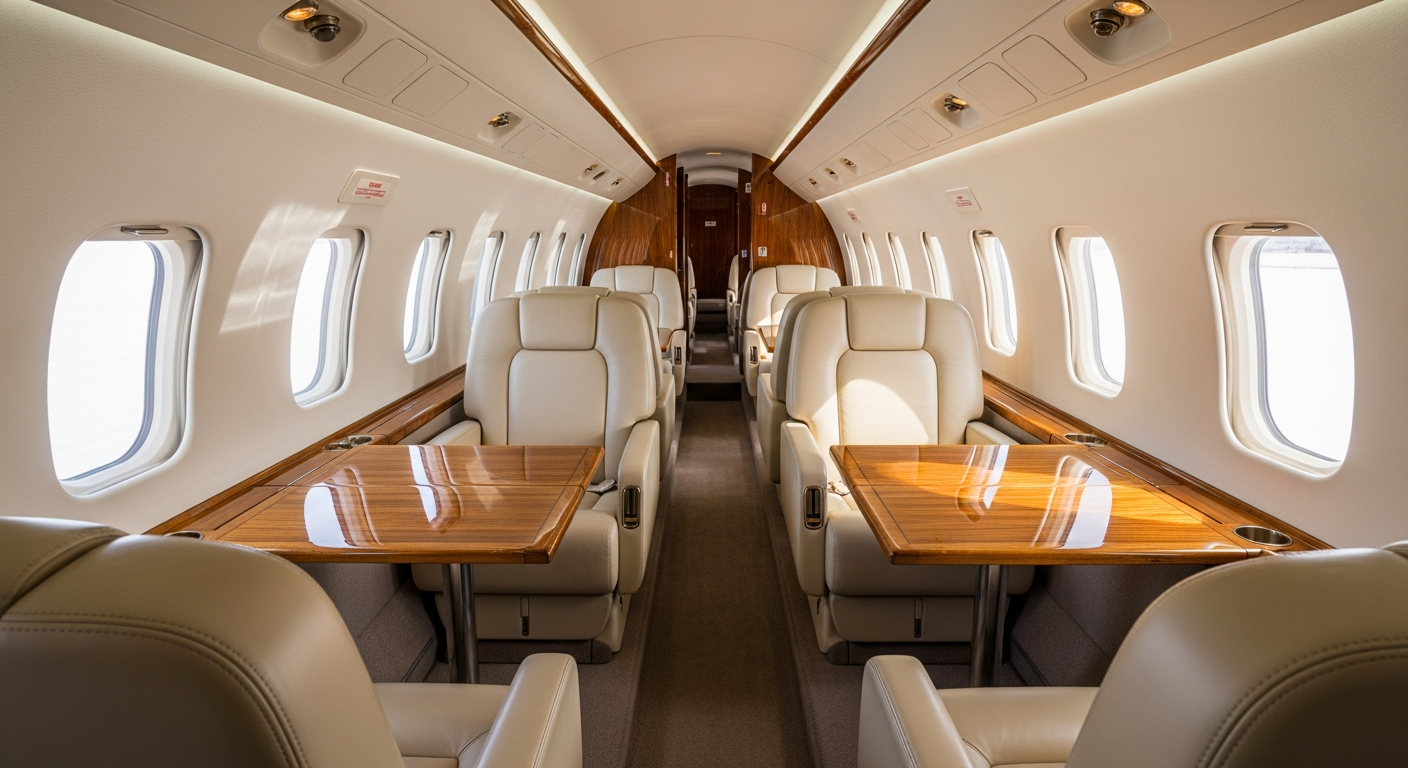
Full stand-up height runs to 6 ft 0 in (1.82 m) throughout the Praetor 600's cabin, a dimension that holds from the forward galley to the aft lavatory without crouching at any point. Cabin width measures 6 ft 10 in (2.08 m): ten inches broader than the Citation Longitude's 6 ft 0 in cross-section, a measurable improvement in shoulder room and visual spaciousness on long sectors. The Bombardier Challenger 350, at 7 ft 1 in, is wider still, but concedes approximately 800 nautical miles of range in return.
Cabin noise is the specification that most distinguishes the Praetor 600 within its segment. Embraer rates the cabin at approximately 62 dB sound pressure at cruise altitude, achieved through active noise and vibration reduction technology integrated into the airframe structure rather than applied as standard passive insulation. Super-midsize aircraft without this system typically register 64–67 dB at equivalent cruise conditions. On a seven-hour westbound transatlantic sector, that difference accumulates: conversations carry at a normal speaking volume, passengers sleep without requiring noise-cancelling equipment, and the fatigue profile on arrival is noticeably lighter.
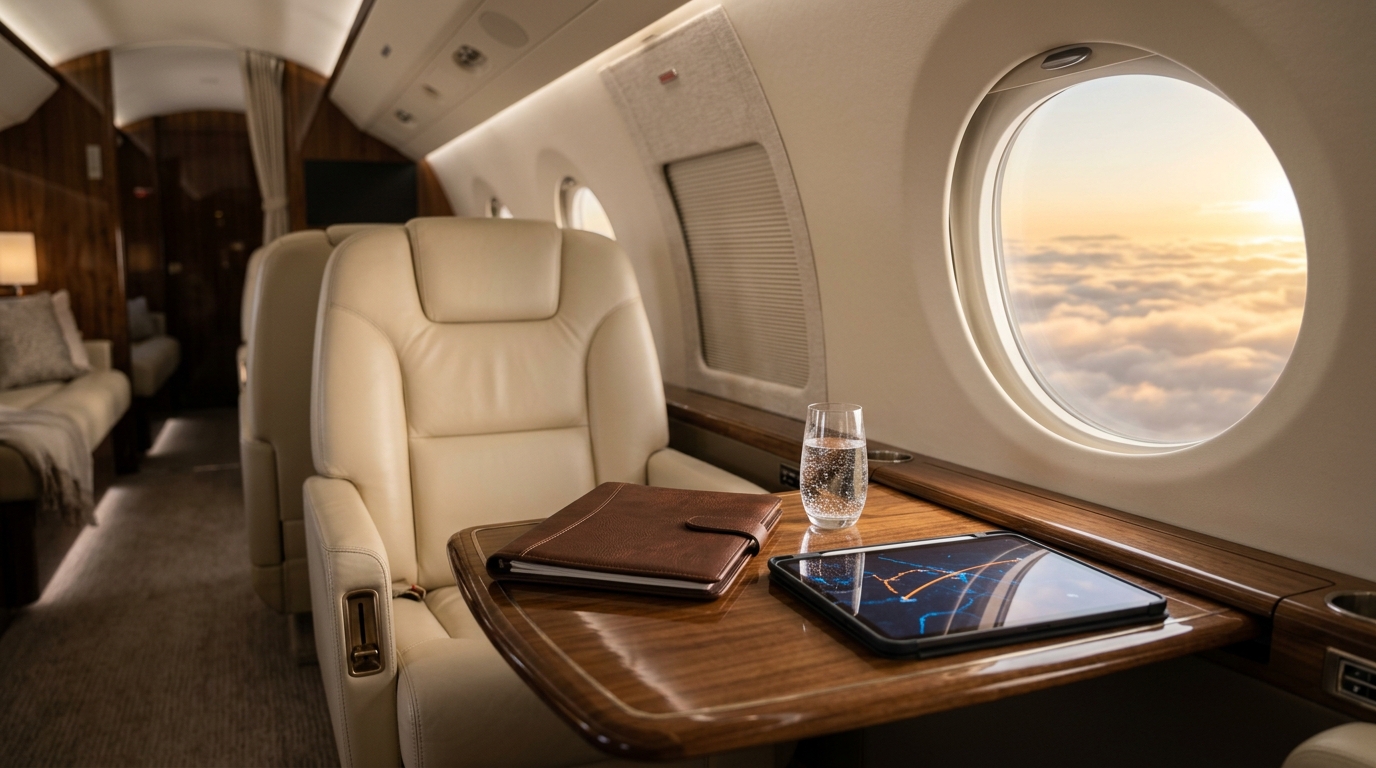
Seating uses individually adjustable chairs with lie-flat capability on the divan, and the forward club configuration allows face-to-face working across a centreline table or individual rest with seat rotation. Window-to-seat alignment runs one per row, which improves natural light distribution throughout a daytime crossing.
Accessible in-flight baggage capacity stands at 195 cubic feet in the aft compartment, sufficient for nine passengers carrying standard checked luggage for a multi-day trip. The forward galley supports the level of catering expected at this charter bracket, while the aft lavatory is serviced through an external door, preserving cabin privacy during turnarounds.
Connectivity on equipped aircraft runs on Gogo AVANCE L5, a system capable of supporting video calls and document transfer at cruising altitude without the compression delays associated with older in-flight satellite systems. For a group managing live business across an eight-hour transatlantic sector, the bandwidth holds to what the cabin's acoustics and comfort level already promise.
Charter Rates and Value: What You Pay Versus a Heavy Jet, and Why It Often Makes Sense
A one-way charter on the Embraer Praetor 600 private jet between Farnborough (EGLF) and New York Teterboro (KTEB) typically runs to £85,000–£100,000 at current European market rates, with variation according to operator, seasonal positioning costs, and lead time. The same routing on a Gulfstream G550 or Bombardier Global 6000 sits at £140,000–£180,000.
The lower rate does not come at the cost of the routing's defining capability. Both categories complete the sector nonstop. Both deliver a full stand-up cabin, in-flight catering service, and professional crew. The heavy-jet platforms offer a broader cabin cross-section: the Global 6000 at 7 ft 2 in and the G550 at 7 ft 4 in, compared with the Praetor 600's 6 ft 10 in. On trips requiring nonstop range beyond 4,000 nautical miles, the G650ER and Global 7500 are the relevant platforms. For a group of seven to nine passengers flying a single transatlantic sector that falls within the Praetor 600's natural range envelope, the premium over the super-midsize rate reflects category positioning rather than a capability the trip actually requires.
The per-seat arithmetic makes the comparison concrete. At a £90,000 charter rate across nine passengers, the Praetor 600 costs approximately £10,000 per person on an EGLF–KTEB sector. On the equivalent heavy-jet booking at £155,000 across nine seats, the per-seat figure rises to approximately £17,200. For clients who prefer to hold that gap and apply it elsewhere, the calculation stands without further qualification.
The exception is any routing that takes the trip beyond the Praetor 600's range envelope without a fuel stop: South America, Sub-Saharan Africa, South or South-East Asia. For those programmes, the Dassault Falcon 8X and Gulfstream G650ER carry their rate premium with genuine nonstop capability that the super-midsize category cannot replicate.
When to Specify the Praetor 600: Ideal Routes, Group Sizes, and Trip Profiles
Six to nine passengers, a sector falling between 2,000 and 3,800 nautical miles, and a trip profile that stays within the Atlantic basin or Gulf region: these three parameters describe the conditions under which the Embraer Praetor 600 private jet consistently makes the strongest case.
The UK to Middle East circuit is the aircraft's most natural repetitive use. Charter clients running regular trips between Farnborough and Dubai (OMDB), Riyadh (OERK), or Abu Dhabi (OMAA) find that the Praetor 600's nonstop capability across nine seats, combined with a rate typically running to £55,000–£65,000 one-way on that routing, covers their requirements without stepping into the heavy-jet bracket. The Citation Longitude requires a fuel stop on some Riyadh routings depending on wind and payload; the Challenger 350 requires one consistently. The Praetor 600 does not.
For smaller parties on shorter sectors, the logic shifts. Four passengers flying London to Nice (LFMN) or Farnborough to Zurich (LSZH) will find the Praetor 600 priced above what those routings genuinely require. A Phenom 300E or Citation CJ4 covers those sectors comfortably, at a charter rate appropriate to the group size and distance. The super-midsize bracket earns its premium when the range, the seat count, or both are in active use.
Clients extending from intra-European charter into their first transatlantic routings frequently arrive at the Praetor 600 as the initial recommendation from their broker. Experienced operators in the European charter market have flagged a consistent increase in clients specifying it by name rather than by category, which reflects a broadening familiarity with its specific capabilities. The aircraft does not compete with the Gulfstream G700 or Dassault Falcon 10X on ultra-long range, nor with the Global 7500 on cabin volume. What the Embraer Praetor 600 private jet offers, reliably, is transatlantic capability, a stand-up cabin rated at 62 dB for genuinely productive long-sector work, and a charter rate that sits meaningfully below the heavy-jet floor.